Polymers — the complete exam guide
From monomer to polymer to full mark answer. Every NESA dot point, every common exam verb, every memorisation hook — built from 7 years of HSC papers (2019–2025) and 298 trial papers.
📍 Pick your path — how to use this guide
Read in order: Part 1 → Part 2 → Part 3. Self-check questions as you go. ~2 hr.
Skim TL;DR → Master Table → drill MCQ Quiz + Model Answers. ~50 min.
Cheat Sheet → Pre-Exam Checklist → flip through Flashcards. ~25 min.
⚡ TL;DR — what every student must know
A polymer is a long-chain molecule made of thousands of repeating units (monomers). NESA only tests 2 dot points but turns them into 9 different verbs in past exams. Here's the entire IQ6 at a glance:
C=C double bonds open out → C–C single bonds. Needs unsaturated monomer + catalyst. 4 syllabus polymers: PE PVC PS PTFE
Two functional groups link, eliminating H2O. 2 syllabus polymers: Nylon PET · plus Kevlar PHB (extension topics).
Use → Properties (×2-3) → Structure (crystallinity / branching / side groups / polar bonds). Every compare-and-contrast Q wants this chain.
Calculate polymer molar mass from monomer + n. Different formula for addition vs condensation. Directly tested in 2025 HSC Q16. → See §3.3
If asked to draw the polymer — show at least 3 monomer units. NESA marker rubric.
🧭 Backbone Diagnostic — read this once, use it on every polymer question
Whenever an exam shows you a polymer structure (named or unseen) and asks "is this addition or condensation?", look only at the backbone — ignore the side groups.
Backbone is an uninterrupted chain of C–C single bonds only. No O, no N, no C=O in the backbone. (Side groups can be anything: H, Cl, phenyl, F, …)
Backbone contains ester (–CO–O–) or amide (–CO–NH–) linkages at regular intervals. Find the linkage → cut across it → you get back the monomers.
Addition polymerisation can only break C=C π bonds, so the backbone is forced to be C–C. Condensation forms a new bond between two functional groups, so the backbone carries that linkage as evidence.
Worked use: 2025 HSC Q28 (Kevlar) — the backbone shows –CO–NH– linkages → amide → condensation. 2024 HSC Q22 (vinyl fluoride) — the backbone is C–C only with F side groups → addition. Same 5-second test, two different exam questions.
Part 1 · Addition Polymers
PE, HDPE, LDPE, PVC, PS, PTFE — the 4 syllabus polymers plus polyethylene's two flavours.
1.1 Introduction to Polymers
A polymer is a long-chain molecule made of thousands or millions of repeating units called monomers. The word comes from Greek — poly = many, mer = unit. So a poly-mer is literally "many units."
Polymer
A long-chain molecule formed by the reaction of thousands or millions of repeating units (monomers). Examples: polyethylene, nylon, DNA.
Monomer
A small reactive molecule that can chain-link to form polymers. Conditions vary by polymerisation type.
Polymerisation
The chemical process by which monomers join to form a polymer. Two types in HSC: addition and condensation.
Natural vs Synthetic Polymers
Polymers occur naturally and can be synthesised industrially.
- Natural polymers: cellulose (plant cell walls), silk and hair (proteins), DNA, natural rubber.
- Synthetic polymers: often called "plastics" — polyethylene shopping bags, PVC pipes, polyester clothing, nylon stockings, PTFE non-stick cookware.
Synthetic Polymers vs "Plastics" — a chemist's distinction
In everyday speech, "plastic" means a synthetic material. For chemists, "plastic" describes a property — a substance is plastic if it is malleable, pliable, and mouldable under heat and pressure.
Therefore: all plastics are synthetic polymers, but not all synthetic polymers are plastics. Synthetic polymers split into 4 categories based on their intermolecular forces.
The 4 Categories of Synthetic Polymers
| # | Category | Behaviour on heating | Examples | Maps to |
|---|---|---|---|---|
| 1 | Thermoplastics | Soften, can be re-moulded → recyclable | PE, PP, PVC, PS, PTFE | Addition (Part 1) |
| 2 | Thermosetting plastics | Irreversibly harden → not recyclable | Bakelite, melamine, polyurethane foam | (structural reference only) |
| 3 | Elastomers | Both viscosity + elasticity | Natural rubber, neoprene | (structural reference only) |
| 4 | Synthetic fibres | Thread-like, woven into fabric | Nylon, polyester | Condensation (Part 2) |
✏️ Mapping to this guide: Category 1 → Part 1 (Addition polymers, PE/PVC/PS/PTFE), Category 4 → Part 2 (Condensation polymers, Nylon/PET). Categories 2 and 3 appear only as structural contrasts.
Thermoplastics vs Thermosetting — quick contrast
Thermoplastics — including every syllabus polymer in this guide (PE, PVC, PS, PTFE, Nylon-6,6, PET) — have weak intermolecular forces between chains. Heat overcomes these → chains slide → polymer melts and re-moulds. By contrast, thermosetting plastics (e.g. Bakelite) have covalent cross-links tying chains together — heat cannot break these without decomposing the polymer. This contrast is included only for context; NESA does not test thermosetting plastics directly.
1.2 Addition Polymerisation — Mechanism
Addition polymerisation is the process of forming a polymer through a series of addition reactions between unsaturated monomers in the presence of an initiator or catalyst.
Step 1 · Addition Reaction Revision (from IQ1)
An addition reaction is a reaction in which an unsaturated molecule (with a C=C or C≡C bond) gains atoms by breaking the π-bond. The double bond opens up; no atoms are eliminated. (Compare with substitution, which exchanges one group for another, and condensation, which eliminates a small molecule.)
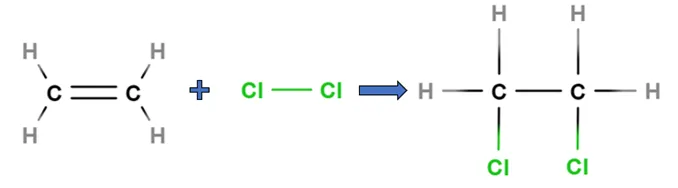
Step 2 · The Polymerisation Mechanism
In addition polymerisation, instead of ethene + Cl2, we have ethene + ethene + ethene + …. Each π-bond breaks under the influence of a catalyst at high temperature and pressure, freeing one electron per carbon to form a new covalent bond with the next monomer.
- One bond in each C=C breaks (π-bond breaks).
- Each carbon now has an unpaired electron.
- New C–C bonds form between adjacent ethene molecules → long chain of repeating −CH2−CH2− units.
General equation:
n CH2=CH2 → −(CH2−CH2)n−
where n = the number of monomer units in the polymer chain (typically 103–105).
Addition polymerisation needs a catalyst or initiator together with high temperature and pressure to break the C=C π-bond. The exact catalyst type determines whether chains end up branched or linear — this is what causes the LDPE vs HDPE difference. When explaining LDPE/HDPE in an exam, mention "different catalyst conditions" — you do not need to name the catalysts.
Catalyst names & industrial conditions Background context — not assessable
NESA has not examined specific catalyst names in any HSC paper 2019–2025. The following is offered for curiosity / context only — students do not need to memorise it.
- LDPE — made with a free-radical initiator (e.g. organic peroxide) under very high pressure → branched chains.
- HDPE — made with a coordination catalyst (e.g. Ziegler–Natta) under milder conditions → linear chains.
Optional — Free-radical mechanism (Initiation / Propagation / Termination) Out of syllabus, but tested in NEAP 2024 Q11
Stage 1 · Initiation: A free radical (from peroxide R–O–O–R) attacks the C=C of an ethene monomer. A new C–C bond forms; the other carbon now carries an unpaired electron — a new free radical.
Stage 2 · Propagation: The new free radical attacks the next ethene monomer. The chain grows by one CH2–CH2 unit at a time. This repeats thousands of times.
Stage 3 · Termination: Two free-radical chain ends combine, forming a single covalent bond and ending the reaction.
When a question asks you to draw the polymer from a monomer, always show at least 3 monomer units in the structural formula. Two units do not count as a "polymer" for marking purposes. (Source: NESA Marking Guidelines and consistent practice across past HSC marker reports.) The abbreviated form −(...)n− is also acceptable and should ideally be drawn alongside.
Naming Addition Polymers
Place the prefix poly- in front of the monomer name. Use brackets when the monomer name is two words or starts with a number.
| Monomer (common name) | Monomer (systematic / IUPAC) | Polymer name | Abbrev. |
|---|---|---|---|
| Ethylene | Ethene | Polyethylene (IUPAC: polyethene) | PE |
| Vinyl chloride | Chloroethene | Poly(vinyl chloride) | PVC |
| Styrene | Ethenylbenzene (also phenylethene · or vinylbenzene) | Polystyrene | PS |
| Tetrafluoroethylene | Tetrafluoroethene | Polytetrafluoroethylene (Teflon™) | PTFE |
⚠️ Note: "phenylbenzene" is not a synonym for styrene — that name refers to biphenyl. Acceptable IUPAC names for styrene's monomer are ethenylbenzene (preferred IUPAC name, treating benzene as the parent) or phenylethene (treating ethene as the parent). The older common name "vinylbenzene" is also valid.
Distinguishing Test — Bromine Water
A common exam question asks: "How would you distinguish the monomer from the polymer using a chemical test?"
- Monomer (e.g. ethene) — has C=C double bond → decolourises brown bromine water (addition reaction adds Br across the double bond).
- Polymer (e.g. polyethylene) — only C–C single bonds → no reaction with bromine water.
This is a direct application of the bromine test for unsaturation from IQ1 Hydrocarbons. Tested explicitly in PEM 2019 Q33 and Loreto 2019 Q26 (both 3-4 marks).
1-Mark Gateway Question — why is the polymer a solid but the monomer a gas?
Frequently asked as a 1-mark "warm-up" before harder polymer Qs (Independent 2020 Q35(a), Hurlstone 2020 Q31(a)).
Worked Example — Drawing the polymer from a monomer
Given the monomer vinyl chloride (chloroethene), CH2=CHCl, draw the addition polymer formed.
Step 1. Identify the C=C and the substituent: H, H, H, Cl.
Step 2. Open the C=C and link 3 monomer units (minimum) by C–C single bonds.
Step 3. Show both the full structural form and the abbreviated bracketed form:
Full: −CH2−CHCl−CH2−CHCl−CH2−CHCl− (3 monomer units shown)
Abbreviated: −(CH2−CHCl)n−
Self-check — what's wrong with this answer? "The polymer is CH2=CHCl repeated many times."
Two errors:
- The polymer does not contain C=C double bonds — those have opened out to form C–C single bonds. Writing CH2=CHCl describes the monomer, not the polymer.
- "Repeated many times" is vague. Show at least 3 explicit monomer units AND/OR the bracketed −(...)n− form.
1.3 Comparing PE / PVC / PS / PTFE — Structure → Properties → Uses
The 4 syllabus addition polymers are all derivatives of ethene. Replacing one or more H atoms of ethene with another substituent gives the monomer that builds each polymer:
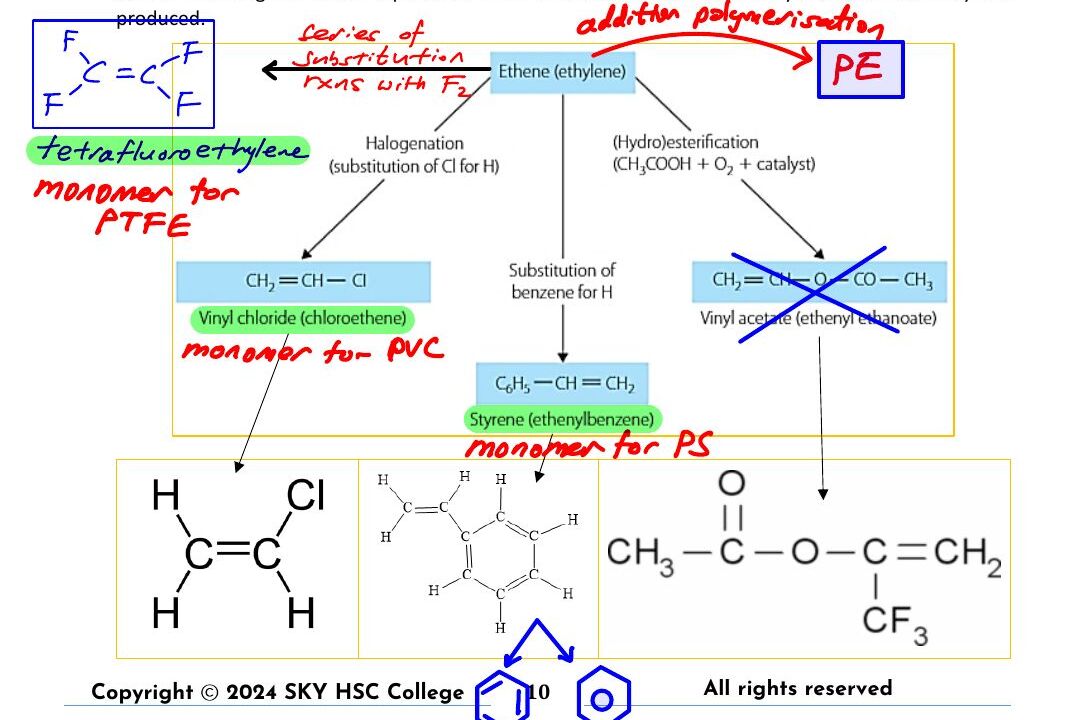
Ethene (ethylene, C2H4) is the master starting material. Replace 1 H → vinyl chloride / ethenylbenzene. Replace all 4 H with F → tetrafluoroethene.
Structure: Molecular Comparison
| Polymer | Monomer (common name) | Monomer (systematic) | Polymer abbreviated structure | Distinguishing feature |
|---|---|---|---|---|
| PE Polyethylene | Ethylene | Ethene (IUPAC) | −(CH2−CH2)n− | No side group — essentially a long alkane |
| PVC Poly(vinyl chloride) | Vinyl chloride | Chloroethene | −(CH2−CHCl)n− | Polar C–Cl side group |
| PS Polystyrene | Styrene | Ethenylbenzene (or phenylethene) | −(CH2−CH(C6H5))n− | Bulky phenyl side group (the largest of the 4) |
| PTFE Polytetrafluoroethylene | Tetrafluoroethylene (Teflon™) | Tetrafluoroethene | −(CF2−CF2)n− | All H replaced by F; symmetric → no net dipole |
Self-check — what does the n subscript actually mean?
n is the number of monomer units in the polymer chain. It's typically 103 to 105, but the exact value varies — that's why polymer samples have a range of molecular weights (called polydispersity).
The Polymer Comparison Checklist core
Properties of any addition polymer depend on 4 structural factors. Memorise these 4 — they're the comparison checklist for every Part 1 polymer.
1 Crystallinity
How ordered the chains pack. Crystalline = aligned, regular → opaque/translucent, high density, more rigid, sharp m.p., chemically more resistant. Amorphous = random → transparent, lower density, more flexible, gradual softening.
2 Branching
Low branching (linear) → chains pack tightly → higher density, more crystalline, rigid. High branching → chains can't pack → lower density, more amorphous, flexible. Branching is the single biggest difference between LDPE and HDPE.
3 Chain length
Longer chains → more atoms → stronger dispersion (London) forces per chain → higher melting point, higher tensile strength, slower flow. Why polyethylene is solid at RT but ethene is a gas.
4 Side groups
Two sub-factors: presence (polar groups like C–Cl add dipole-dipole forces) and size (bulky groups like phenyl prevent chains from packing).
📌 Relationship to memorise: size of side group ∝ stiffness.
📝 Apply the Checklist — LDPE (preview)
See how the 4 factors work together for LDPE (you'll get all 5 polymers in §1.4):
- 2 Branching: high (many side branches) → chains cannot pack closely → leads to ↓
- 1 Crystallinity: low (amorphous) → leads to ↓
- Property output: low density (~0.92 g/cm³) + flexible + translucent.
- 4 Side groups: none (just H) → non-polar backbone → dispersion forces only → chemically inert.
Marker phrase: "structure → packing → IMF type → property". This is the chain every NESA answer should follow.
Properties of Polyethylene — LDPE vs HDPE
Polyethylene exists in two industrial forms that differ only in chain branching — yet their properties are dramatically different. This is the canonical "branching changes everything" case study.
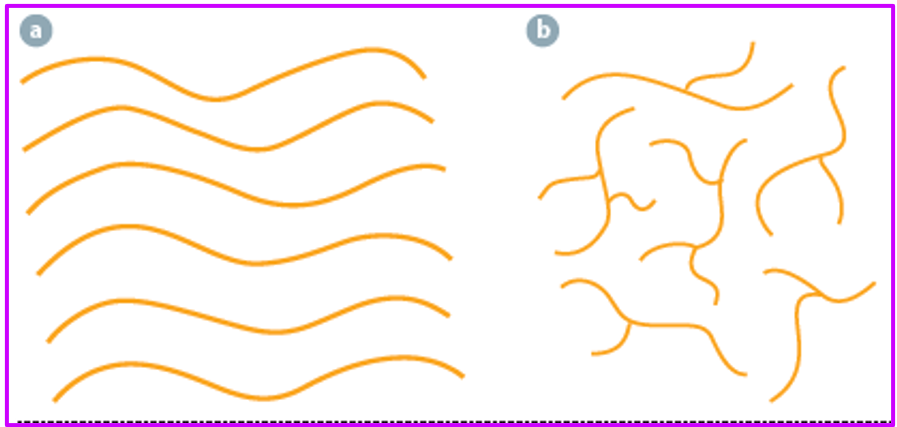
| Property | LDPE amorphous | HDPE crystalline |
|---|---|---|
| 2 Branching | High (many side branches) | Low (linear chains) |
| 1 Crystallinity | Amorphous | Crystalline |
| Density | Low (~0.91–0.94 g/cm³) | High (~0.94–0.97 g/cm³) |
| Melting point | Lower (~105–115 °C) | Higher (~130–135 °C) |
| Transparency | Transparent / translucent | Opaque |
| Flexibility | Flexible, soft | Rigid, hard |
| Chemical resistance | Less resistant | More resistant |
The Causal Chain — How to Answer "Compare" Questions
Whenever NESA asks "compare the uses of X and Y" or "explain why X is used for Z", the marker wants this 3-link chain:
USE ← justified by ← PROPERTIES (×2-3) ← justified by ← STRUCTURE
Example for LDPE = plastic bag:
Use: plastic shopping bag → requires properties: flexible (so it folds), lightweight, low cost, chemically inert (food contact) → justified by structure: high branching → chains can't pack → amorphous → flexible + low density; pure hydrocarbon → non-polar → chemically inert.
Self-check — apply the chain. Why is HDPE used for milk jugs?
Use: milk jug → requires: rigid (holds shape when full), high m.p. (survives dishwasher), opaque (blocks UV degradation of milk), chemically inert (food contact) → justified by structure: linear chains (low branching) → tight packing → crystalline → rigid + high m.p. + opaque (light scattering off crystal domains); pure hydrocarbon → non-polar → chemically inert.
1.4 The 4-Step Model Answer Scaffold — Addition Polymers
Almost every "compare-and-contrast" or "discuss the structure / properties / uses" question on addition polymers can be answered with this 4-step scaffold. NESA markers reward this structure explicitly — use it on every multi-mark addition polymer question.
Worked Example — Compare LDPE and HDPE
Model answer · 6-mark equivalent 6 marks
Step 1 · Equation — Both LDPE and HDPE are produced by addition polymerisation of ethene (ethylene):
n CH2=CH2 → −(CH2−CH2)n−
The difference between LDPE and HDPE arises from the catalyst conditions used: one condition produces branched chains (LDPE), the other produces linear chains (HDPE). The exact catalyst names are not required for HSC marks.
Step 2 · Uses
LDPE: plastic shopping bags, cling wrap.
HDPE: milk jugs, water pipes, buckets.
Step 3 · Properties
LDPE: flexible (phys), low density ~0.92 g/cm³ (phys), translucent (phys), chemically inert (chem).
HDPE: rigid (phys), high density ~0.95 g/cm³ (phys), opaque (phys), chemically inert (chem).
Step 4 · Structure
LDPE: high degree of branching → chains cannot pack closely → low crystallinity (amorphous) → low density, flexibility, translucence.
HDPE: low branching (linear chains) → tight packing → high crystallinity → high density, rigidity, opacity.
Both are chemically inert because the polymer backbone has only strong, non-polar C–C and C–H bonds — and no polar functional groups (no –OH, –COOH, –NH2, no double bonds) that acids, bases, or water could attack.
Per-Polymer 5-Step Summary Cards — for memorisation
Each of the 5 addition polymers below has its own 5-step summary card following the scaffold above. Use these as flashcards before the exam — one card per polymer, with the monomer + abbreviated polymer structure included for easy reference.
LDPE — Low-Density Polyethylene
PE![LDPE — Low-Density Polyethylene (branched): ethene monomer + 3-unit chain with explicit side branch + bracket form [-CH2-CH2-]n. Branched chains prevent packing → amorphous.](diagrams/iq6-ldpe-structure-v2.png)
- Equation: n CH2=CH2 → −(CH2−CH2)n− (free-radical conditions; branched chains)
- Use: plastic shopping bags, cling film, squeeze bottles — needs flexibility + low cost + chemical inertness.
- Properties: flexible (phys) · low density ~0.92 g/cm³ (phys) · translucent (phys) · chemically inert (chem).
- Structure → Properties chain:
- High degree of branching → chains physically cannot pack closely → amorphous (low crystallinity) → low density (lots of empty space) + flexible (chains slide past each other easily) + translucent (no large crystal domains to scatter light).
- Side group: none (just –H) → pure non-polar C–C/C–H backbone.
- Chain length: long (~103–105 units) → enough dispersion forces to be solid at RT, but no polar attractions → low m.p. (~110 °C).
- Polar bonds: none — pure non-polar C–H/C–C backbone → only weak dispersion (London) forces between chains → chemically inert (no functional groups for acids/bases/water to attack) + low m.p.
📝 Sample exam answer (3 marks) — "Why is LDPE used for plastic shopping bags? Refer to its structure."
LDPE has highly branched polyethylene chains, so the chains cannot pack closely together. This produces an amorphous structure with low density (~0.92 g/cm³), making LDPE flexible — the chains slide past each other easily when stretched, so the material folds without breaking. The pure non-polar C–C/C–H backbone gives LDPE chemical inertness, which is essential for food contact. The combination of flexibility + low cost + inertness makes LDPE ideal for plastic shopping bags.
⚠️ Top 2 mistakes: (1) Saying LDPE has "low molecular weight" — wrong; LDPE chains are still long. Branching, not chain length, is what lowers density. (2) Confusing LDPE and HDPE — they're the same polymer chemistry; only the chain geometry (branched vs linear) differs.
HDPE — High-Density Polyethylene
HDPE![HDPE — High-Density Polyethylene (linear): ethene monomer + two parallel straight 6-carbon chains + bracket form [-CH2-CH2-]n. Unbranched chains pack tightly in parallel → crystalline.](diagrams/iq6-hdpe-structure-v2.png)
- Equation: n CH2=CH2 → −(CH2−CH2)n− (coordination catalyst; linear chains)
- Use: milk jugs, water pipes, buckets, toys — needs rigidity + durability + opacity (food contact).
- Properties: rigid (phys) · high density ~0.95 g/cm³ (phys) · opaque (phys) · chemically inert (chem).
- Structure → Properties chain:
- Low branching (linear chains) → chains pack tightly together → highly crystalline → high density (~0.95) + rigid (chains can't slide past each other) + opaque (crystal domains scatter light).
- Side group: none → pure non-polar C–C/C–H backbone, same as LDPE.
- Tighter packing → stronger total dispersion forces → higher m.p. (~135 °C) than LDPE despite identical chemistry.
- Polar bonds: none — same backbone as LDPE; the difference (rigidity, density, opacity) comes entirely from packing geometry, not from polarity or chemistry.
📝 Sample exam answer (3 marks) — "Why is HDPE used for milk jugs? Refer to its structure."
HDPE has linear (unbranched) polyethylene chains, which pack tightly together in a highly crystalline structure. This high crystallinity gives HDPE rigidity (the milk jug holds its shape under the weight of the liquid) and opacity (the crystal domains scatter light, blocking UV that would degrade the milk inside). The pure non-polar C–C/C–H backbone provides chemical inertness, essential for food contact. Rigidity + opacity + inertness make HDPE the ideal material for milk jugs.
⚠️ Top 2 mistakes: (1) Treating HDPE as "different chemistry" from LDPE — they share the same ethene monomer and C–C backbone; only the chain arrangement differs. (2) Forgetting that HDPE's stronger inter-chain attraction comes from closer packing → more dispersion contact, NOT from any polar group.
PVC — Poly(vinyl chloride)
PVC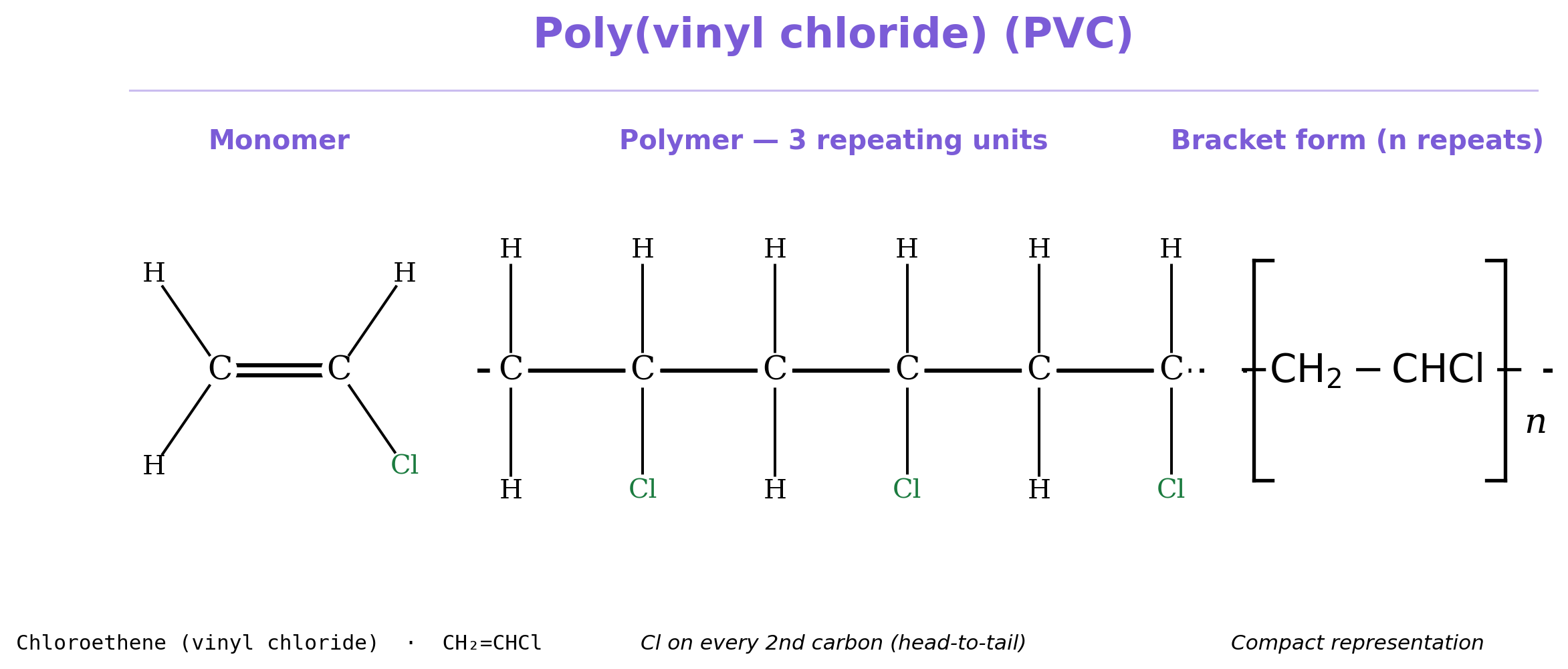
- Equation: n CH2=CHCl → −(CH2−CHCl)n− (monomer: vinyl chloride / chloroethene)
- Use: PVC pipes (rigid form), electrical wire insulation (flexible form), window frames, vinyl flooring.
- Properties: rigid (phys) · slightly transparent (phys) · higher m.p. than PE (phys) · chemically inert (chem).
- Structure → Properties chain:
- Polar C–Cl side group on every second carbon → permanent dipole → dipole-dipole forces between chains (stronger than PE's dispersion-only) → more rigid + higher m.p. than PE.
- Low branching + intermediate crystallinity → chains pack moderately well → slightly transparent (smaller crystal domains than HDPE).
- Stable C–Cl and C–C bonds in the backbone → chemical inertness in everyday conditions (no –OH/–COOH for acids/bases to attack).
- Polar bonds: C–Cl is polar → permanent dipole on every other C → dipole-dipole IMFs between chains → key difference from PE.
📝 Sample exam answer (4 marks) — "Compare PVC and PE. Explain why PVC is more rigid than PE."
Both PVC and PE are addition polymers of ethene derivatives. The key structural difference is the side group: PE has only hydrogen atoms, while PVC has a chlorine atom on every second carbon. The C–Cl bond is polar (Cl is much more electronegative than C), creating a permanent dipole. This means PVC chains attract each other through dipole-dipole forces in addition to dispersion forces. PE chains, having only non-polar C–C/C–H bonds, attract each other through dispersion forces alone. The stronger inter-chain forces in PVC restrict chain movement, making PVC more rigid with a higher melting point than PE.
⚠️ Top 2 mistakes: (1) Saying PVC forms H-bonds — Cl is electronegative but has no H attached to it, so PVC has dipole-dipole only, NOT H-bonds. (2) Treating "flexible PVC" and "rigid PVC" as different polymers — both are PVC; the only difference is plasticiser additive.
PS — Polystyrene
PS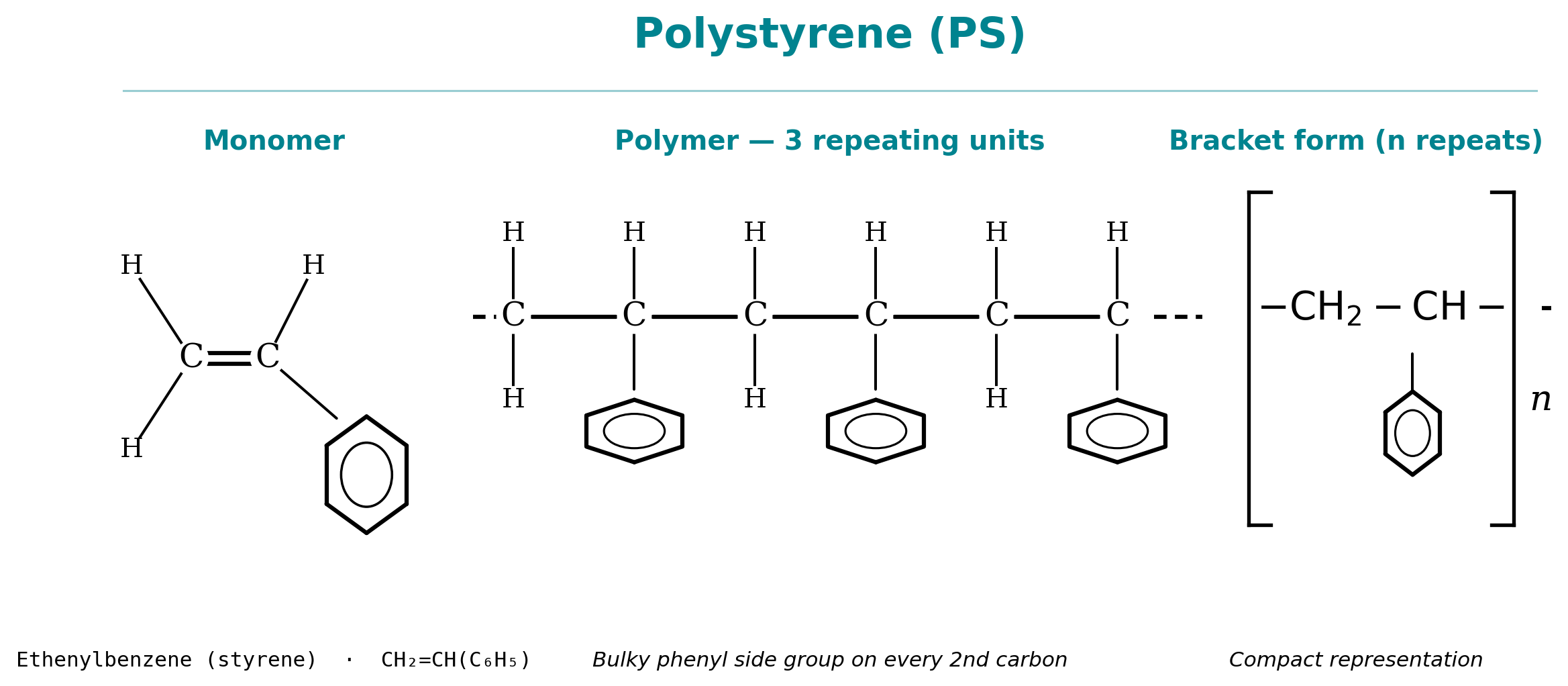
- Equation: n CH2=CH(C6H5) → −(CH2−CH(C6H5))n− (monomer: styrene / ethenylbenzene)
- Use: CD cases, plastic cutlery (Type 1 commercial) · foam packaging, disposable cups (Type 2 Styrofoam — gas-expanded).
- Properties: brittle (phys) · transparent — Type 1 (phys) · lightweight (phys) · chemically inert in everyday conditions (chem).
- Structure → Properties chain:
- Bulky phenyl (C6H5) side group on every second C → chains cannot pack regularly → atactic (amorphous) → transparent (no crystal domains) + brittle (no crystal reinforcement to absorb stress).
- No polar groups, no N–H/O–H → the only inter-chain force is the weak dispersion (London) force. (NESA's 2025 Q28 marking guideline treats PS as dispersion-only — don't add π-stacking for marks.)
- Type 2 (expanded Styrofoam) — same polymer, gas-blown to ~95% air → very lightweight + excellent thermal/acoustic insulator (trapped air = poor heat conductor).
- Polar bonds: none — phenyl is non-polar. Dispersion forces only.
📝 Sample exam answer (3 marks) — "Why is foam polystyrene used for disposable cups, but solid polystyrene used for CD cases?"
Both are made from the same polystyrene polymer (atactic, amorphous structure due to bulky phenyl side groups), but differ in processing. Foam polystyrene (Type 2 Styrofoam) is gas-expanded to ~95% air, making it very lightweight and an excellent thermal insulator (trapped air conducts heat poorly) — ideal for disposable hot-drink cups where the user's hand needs protection from heat. Solid (Type 1) polystyrene retains the amorphous transparency of the unfoamed polymer, giving rigid + transparent properties needed for CD cases (rigid to protect disc, transparent so the cover artwork is visible).
⚠️ Top 2 mistakes: (1) Saying the phenyl ring provides H-bonds or dipole–dipole — phenyl is non-polar; PS has dispersion forces only. (2) Confusing styrene (the monomer CH2=CHC6H5) with Styrofoam (the expanded form of polystyrene).
PTFE — Polytetrafluoroethylene (Teflon)
PTFE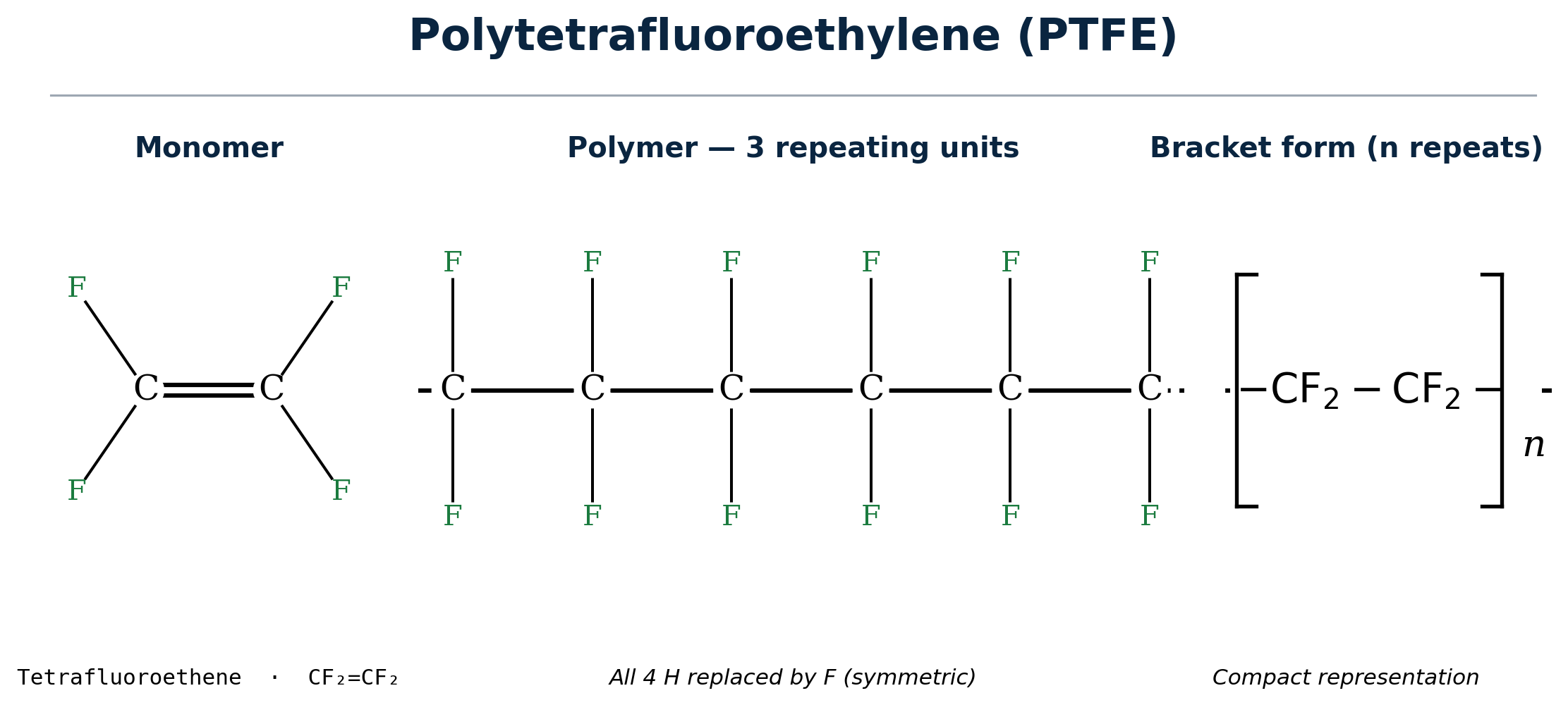
- Equation: n CF2=CF2 → −(CF2−CF2)n− (monomer: tetrafluoroethene — all 4 H of ethene replaced by F)
- Use: non-stick cookware, plumber's tape, bearings, electrical insulation — needs heat resistance + low friction + inertness.
- Properties: very low friction (phys) · very high m.p. (phys) · extremely chemically inert (chem) · insoluble in most solvents (chem).
- Structure → Properties chain:
- Symmetric F substitution on every C (all 4 H replaced by F) → individual C–F bonds polar BUT symmetric placement cancels the net dipole → no dipole-dipole forces between chains.
- F atoms shield the carbon backbone + extremely strong C–F bonds (strongest single bond to carbon) → extremely chemically inert (resists almost all chemical attack).
- F-rich surface has low electron-donating capacity for IMFs with other materials → very low friction (food doesn't stick; bearings glide).
- Linear backbone + high crystallinity → tight packing → very high m.p. despite no dipole-dipole forces (enhanced dispersion from high F electron density).
- Polar bonds: individual C–F bonds are polar, but symmetric substitution → no net dipole across the chain. Only enhanced dispersion forces (high F electron density). The shielded backbone is what makes PTFE so inert.
📝 Sample exam answer (3 marks) — "Why is PTFE used for non-stick cookware? Refer to its structure."
PTFE has fluorine atoms symmetrically placed on every carbon (all 4 H of ethene replaced). The C–F bonds are very strong (the strongest single bond to carbon), so PTFE is extremely chemically inert — it won't react with food acids or oils. The F-rich surface also has very low friction (electrons in C–F bonds are held tightly by F, so they don't interact strongly with other molecules) — food slides off easily. Tight chain packing gives a very high melting point, so PTFE survives high cooking temperatures. Inertness + low friction + heat resistance = ideal non-stick cookware coating.
⚠️ Top 2 mistakes: (1) Saying PTFE has strong dipole-dipole forces — individual C–F bonds are polar, but symmetric placement cancels the net dipole. (2) Forgetting that PTFE's inertness IS the feature: non-stick pans work because nothing sticks to or reacts with C–F.
1.5 Recycling Addition Polymers — background context, useful for extended-response framing
All 4 syllabus addition polymers (PE, PVC, PS, PTFE) are thermoplastics, so they can be melted and re-moulded rather than decomposed. This makes them recyclable in principle — though the practical recycling rate varies by polymer (PET and HDPE are widely recycled; PVC and PTFE are not).
Recycling codes & environmental implications Background context — not assessable in IQ6
NESA does not examine recycling codes or environmental implications inside IQ6 Polymers — these themes belong to Module 7 IQ4 (Fossil Fuels vs Biofuels) and IQ6 of Module 8. They are presented here for context only.
The 7 Plastic Recycling Codes
| Code | Plastic | Typical use | Recyclability |
|---|---|---|---|
| ♳ 1 | PET | Drink bottles | Widely recycled |
| ♴ 2 | HDPE | Milk jugs | Widely recycled |
| ♵ 3 | PVC | Pipes, flooring | Hard to recycle |
| ♶ 4 | LDPE | Shopping bags | Some programs only |
| ♷ 5 | PP | Yogurt tubs | Increasingly recycled |
| ♸ 6 | PS | Foam cups | Limited |
| ♹ 7 | Other / mixed | Multilayer packaging | Rarely recycled |
Environmental implications (brief): Addition polymers' non-polar C–C/C–H backbone is very stable → not biodegradable, persists for decades to centuries. Biopolymers like PHB (see §3.2) offer a biodegradable alternative.
🎯 Part 1 Mini-Checkpoint — 2 questions before you move on
Q1. Why is HDPE more rigid and denser than LDPE, even though they have the same chemical formula? (3 marks)
HDPE chains are linear and unbranched, allowing them to pack closely in parallel arrangement (high crystallinity). LDPE chains are highly branched, preventing close packing and creating amorphous regions. The close-packed HDPE chains experience stronger total dispersion forces per volume (more contact area), giving HDPE both higher density (~0.95 g/cm³ vs ~0.92 g/cm³) and greater rigidity. Key marker phrase: structure → packing → IMF strength → property.
Q2. A monomer of styrene (C8H8) decolourises bromine water rapidly, but polystyrene does not. Explain. (2 marks)
Styrene contains a reactive C=C double bond (a π-bond) that undergoes electrophilic addition with Br2, decolourising the bromine water. During addition polymerisation, the C=C bond opens out to form C–C single bonds in the polystyrene backbone — there are no remaining π-bonds in polystyrene for bromine to react with, so the orange colour persists. This is the 1-mark "monomer vs polymer" gateway test.
Part 2 · Condensation Polymers
Nylon-6,6 and PET — the 2 syllabus polymers. Functional groups link, water is eliminated.
2.1 Condensation Polymerisation — Mechanism
Condensation polymerisation is the process of forming a polymer by reacting bifunctional monomers together, with the elimination of a small molecule (almost always water) at each link.
How is this different from addition?
| Addition polymerisation | Condensation polymerisation | |
|---|---|---|
| Monomer requirement | Unsaturated (must have C=C) | ≥2 functional groups per monomer (bifunctional) |
| What happens to bonds | π-bond breaks; new C–C single bonds form | Two functional groups condense; H2O eliminated |
| Atom economy | 100% (no atoms lost) | <100% (H2O lost at each link) |
| Backbone | Pure C–C chain | C–C interrupted by –O– or –N(H)– linkages |
| Typical syllabus polymers | PE, PVC, PS, PTFE | Nylon, polyester (PET); also Kevlar, PHB |
The Co-polymer Idea
Most condensation polymers are co-polymers — built from two different monomers joined alternately:
- Polyester (PET): a diacid (terephthalic acid) + a diol (ethylene glycol)
- Polyamide (Nylon-6,6): a diacid (adipic acid) + a diamine (hexamethylenediamine)
- Kevlar: aromatic diacid (terephthalic acid) + aromatic diamine (1,4-diaminobenzene)
A few condensation polymers use a single monomer that has both functional groups on the same molecule — for example, an amino acid (–NH2 at one end, –COOH at the other) self-polymerises into a polypeptide. PHB (poly-3-hydroxybutyrate) works the same way.
🎯 The Master Pattern — every condensation polymer question follows this
Once you see this pattern, every NESA polyester/polyamide question (including unseen monomers like Kevlar or PHB) becomes the same problem. The diagrams below use abstract shapes (green rectangles + blue ellipses) for the carbon backbones — focus on the functional groups at the ends and what they form when they link.
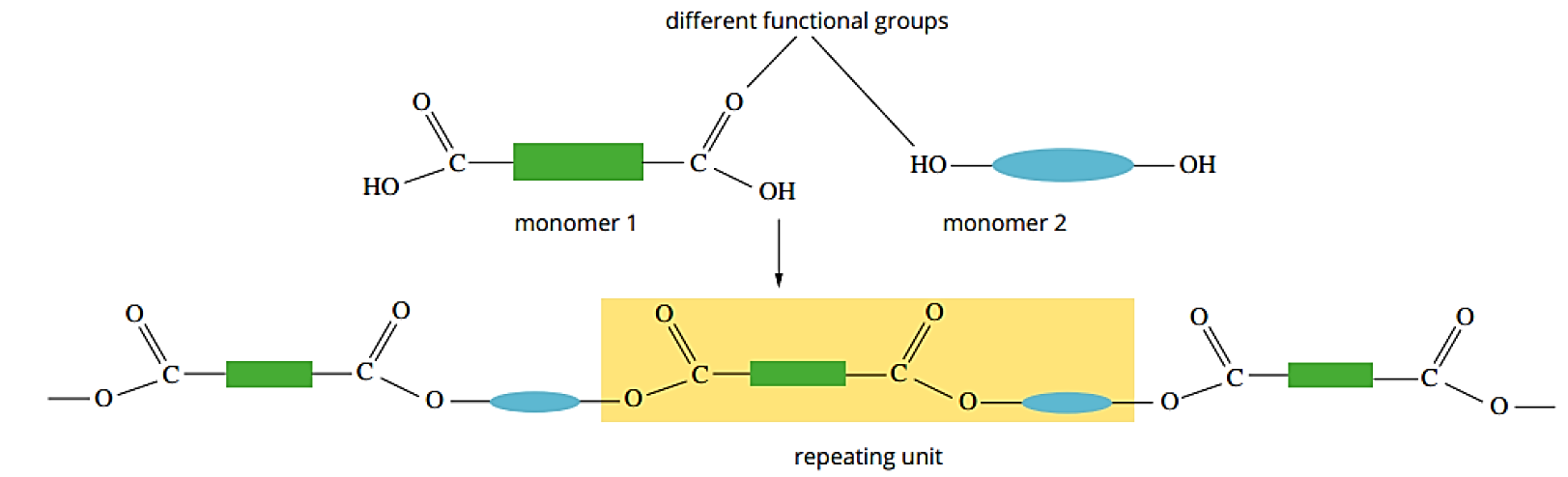
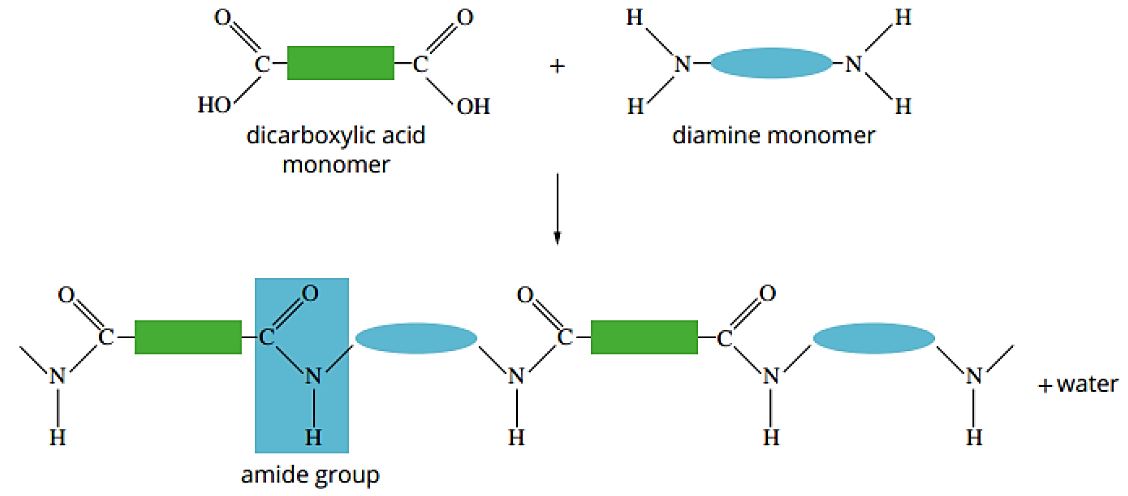
The Functional-Group Rule
Example — Counter-example test
Methanol (CH3OH, one –OH only) + butanoic acid (CH3CH2CH2COOH, one –COOH only) → methyl butanoate (an ester, not a polyester) + H2O. The reaction stops here because neither product has a remaining functional group to keep growing.
By contrast — hexane-1,6-diol (HO–CH2–(CH2)4–CH2–OH, two –OH groups) can react with a dicarboxylic acid (two –COOH) to build a polyester chain indefinitely — because each link still leaves another functional group free to react.
The "Cut-Across-the-Link" Technique — finding monomers from a polymer
The most common exam task is the reverse problem: given a polymer fragment, identify the monomer(s). Master this 3-step recipe:
Step 1. Locate the linkage:
- Ester linkage = –C(=O)–O–
- Amide (peptide) linkage = –C(=O)–N(H)–
Step 2. Cut across the link, between the C=O carbon and the O or N atom.
Step 3. Add H to the side that has N or O (restoring –OH or –NH2). Add OH to the side that has C=O (restoring –COOH).
Why this works: condensation polymerisation eliminated H2O at each link, so "undoing" the link is adding H2O back — one H to one side, one OH to the other.
Worked Example — Identify the monomers
Given a section of polymer with the structure:
⋯ –NH–(CH2)6–NH–C(=O)–(CH2)4–C(=O)–NH–(CH2)6–NH– ⋯
Click to reveal answer — find the two monomers
Step 1 · Identify the linkage: the chain contains –C(=O)–N(H)– → amide linkages → this is a polyamide.
Step 2 · Cut across each amide bond between C=O and N(H).
Step 3 · Add H to N side, OH to C=O side:
Monomer A (diamine): H2N–(CH2)6–NH2 = hexamethylenediamine (hexane-1,6-diamine)
Monomer B (diacid): HOOC–(CH2)4–COOH = adipic acid (hexanedioic acid)
→ This is the polymerisation that produces Nylon-6,6 (see §2.3).
Self-check — can each of these molecules polymerise by condensation?
- CH3COOH (one –COOH)? No — only one functional group; reaction stops at the dimer.
- HOCH2CH2OH (two –OH)? By itself no (two –OH react together → ether, but very unfavourably) — but combined with a diacid like terephthalic acid, yes → polyester (this is the PET monomer pair).
- HOOC–CH2CH2–COOH + H2N–CH2CH2–NH2? Yes — diacid + diamine → polyamide.
- Glycine (H2N–CH2–COOH)? Yes — one molecule has BOTH –NH2 and –COOH at opposite ends → self-polymerises → polypeptide (this is how silk is built, see §3.2).
2.2 Polyester — Polyethylene Terephthalate (PET)
PET is the syllabus polyester. It's the world's most-produced condensation polymer (drinks bottles, polyester clothing, film) — and the one NESA tests most often (2020 HSC Q12, 2025 HSC Q16).
The Two Monomers
Terephthalic acid (diacid)
Systematic name: benzene-1,4-dicarboxylic acid
Structure: HOOC–C6H4–COOH (two –COOH groups para-positioned on a benzene ring)
Role: contributes the aromatic ring + carbonyl C=O dipoles to the chain.
Ethylene glycol (diol)
Systematic name: ethane-1,2-diol
Structure: HO–CH2–CH2–OH (two –OH groups on adjacent carbons)
Role: contributes the short –O–CH2–CH2–O– flexible spacer.
The Polymerisation Equation
n HOOC–C6H4–COOH + n HO–CH2–CH2–OH
↓
–[ O–C(=O)–C6H4–C(=O)–O–CH2–CH2 ]n– + (2n – 1) H2O
Each link eliminates one H2O molecule. A chain of n repeating units has 2n–1 links → 2n–1 water molecules released. Critical for MW calculation — see §3.3.
![PET (polyethylene terephthalate) polymerisation: terephthalic acid (HOOC–C6H4–COOH) + ethylene glycol (HO–CH2CH2–OH) → polyester chain –[O–CH2CH2–O–C(=O)–C6H4–C(=O)]n– with water eliminated at every ester link](diagrams/iq6-d04-pet-polymerisation-v2.jpg)
Structure: what the chain looks like
The PET backbone is an alternation of rigid aromatic rings and short flexible –O–CH2–CH2–O– spacers, linked together by ester groups –C(=O)–O–. Two structural features dominate the properties:
- 4 Polar C=O bonds in the ester linkages → dipole–dipole IMFs between adjacent chains.
- Aromatic rings → π–π stacking between flat benzene rings of neighbouring chains (an enhanced form of dispersion force).
Say this carefully in an exam. The chains are held together by intermolecular forces, not covalent bonds — but do not call them "weak". Any single dipole–dipole or dispersion interaction is weak compared with a covalent bond; the point NESA rewards is that PET has so many of them, over such a long chain, that the total inter-chain attraction is very strong. That is exactly why 2020 HSC Q12 credited: "Extensive dipole–dipole and dispersion forces exist between the polymer chains." — note the word extensive, not "weak".
⚠️ Wording rule for every polymer answer. Reserve the word weak for the type of force (an individual dispersion force is weak) — never for the total attraction between long chains. Write "dispersion forces only, so the total inter-chain attraction is comparatively low" for PE/PS, and "extensive dipole–dipole (PET) / hydrogen bonding (Nylon, Kevlar), so the total inter-chain attraction is high" for the condensation polymers.
Properties
| Property | Value / description | Why (structural reason) |
|---|---|---|
| Melting point | ~250-260 °C | Strong dipole-dipole + π-stacking between chains |
| Crystallinity | Crystalline (or partially crystalline) | Rigid rod-like aromatic backbones align easily |
| Tensile strength | High | Same — chains slide poorly past each other |
| Transparency | Transparent when rapidly cooled (amorphous form); opaque when slow-cooled (crystalline) | Cooling rate controls crystal domain size |
| Stain / water resistance | Hydrophobic surface | Polar groups are buried inside the chain; surface is largely hydrocarbon |
| UV resistance | Good | Aromatic ring absorbs UV without bond cleavage |
| Chemical resistance | Inert to dilute acids/bases; the ester linkage is hydrolysed under strong base conditions | Ester C=O is the polar reactive site |
Uses (linked to properties)
- Drink bottles — transparent (when rapidly cooled), tough (high tensile strength), lightweight, food-safe, recyclable (code 1).
- Polyester clothing fibres — high strength + crystallinity + low water absorption (stays cool, dries fast).
- Magnetic tape, X-ray film, packaging films — flexible when thin, strong, transparent.
- Sportswear / fleece — when recycled (rPET), often spun into fibres for jackets and carpets.
Self-check — why does PET need ~250 °C to soften, but PE only ~110 °C?
PE chains attract each other only by dispersion forces (purely non-polar C–C/C–H backbone). PET chains have multiple polar C=O groups per repeat unit → strong dipole–dipole forces — plus aromatic π–π stacking. To melt PET, you have to overcome both. The energy required is roughly double, hence ~250 °C vs ~110 °C.
This is exactly the answer to 2020 HSC Q12.
2.3 Polyamide — Nylon-6,6
Nylon-6,6 is the syllabus polyamide. It's the textbook example of hydrogen-bonded chain attraction — the same mechanism that makes Kevlar (§3.1), proteins, and silk strong.
The Two Monomers
Adipic acid (diacid)
Systematic name: hexanedioic acid
Structure: HOOC–(CH2)4–COOH (two –COOH groups separated by 4 CH2 groups → total 6 carbons)
Role: contributes the C=O carbonyl half of each amide link.
Hexamethylenediamine (diamine)
Systematic name: hexane-1,6-diamine
Structure: H2N–(CH2)6–NH2 (two –NH2 groups separated by 6 CH2 → total 6 carbons)
Role: contributes the N–H half of each amide link.
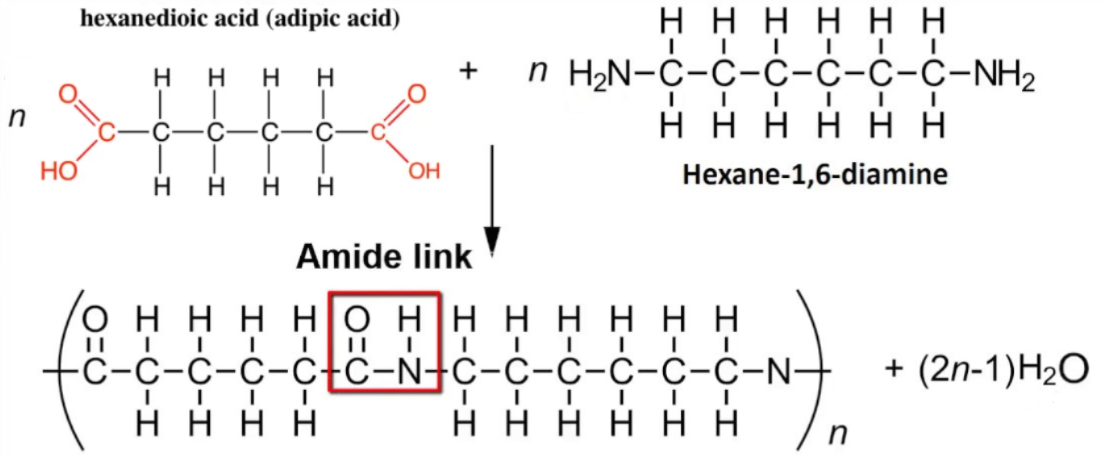
The Polymerisation Equation
The –COOH of adipic acid reacts with the –NH2 of hexamethylenediamine, eliminating H2O at each link. This is the same condensation reaction that joins amino acids into proteins.
n HOOC–(CH2)4–COOH + n H2N–(CH2)6–NH2
↓
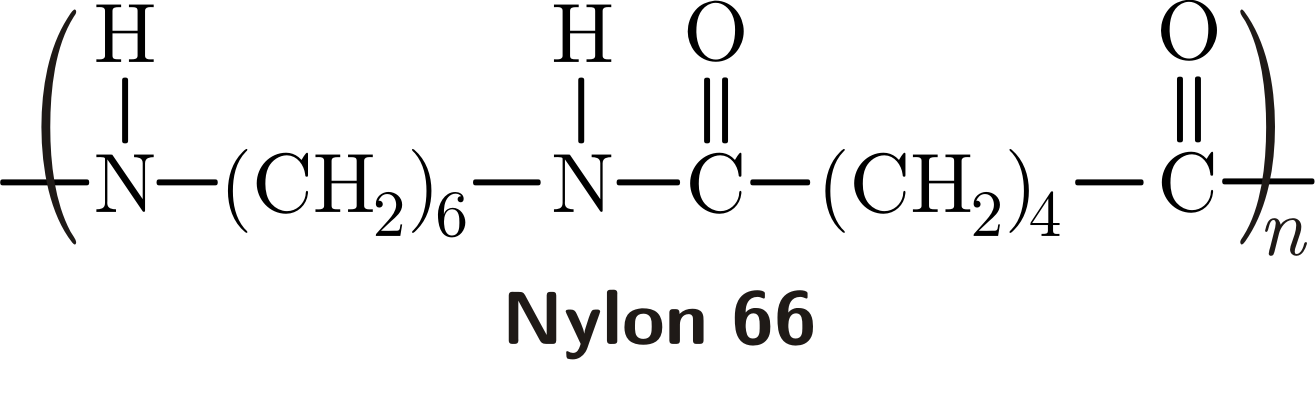
–[ C(=O)–(CH2)4–C(=O)–N(H)–(CH2)6–N(H) ]n– + (2n – 1) H2O
Structure: H-bonding between chains
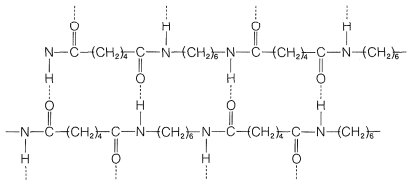
This is where Nylon-6,6 differs dramatically from PE/PVC/PS/PTFE/PET. Every amide group in the chain has both:
- A polar N–H (H is δ+, attached to electronegative N) → H-bond donor
- A polar C=O (O has lone pairs and is δ−) → H-bond acceptor
This means every monomer unit contributes 2 H-bond sites — the N–H of one chain forms a strong hydrogen bond with the C=O oxygen of the adjacent chain. Multiplied across thousands of repeat units, the cumulative IMF is enormous.
Properties
| Property | Value / description | Why (structural reason) |
|---|---|---|
| Melting point | ~265 °C | Strong H-bonds between chains |
| Tensile strength | Very high | H-bond network resists chain slip |
| Elasticity | Springs back from stretch | H-bonds can break and re-form at new positions when chains slide; covalent backbone unchanged |
| Density | Moderately high (~1.14 g/cm³) | Crystalline packing |
| Crystallinity | Highly crystalline | Linear regular backbone packs efficiently |
| Water absorption | Yes — slightly hygroscopic | N–H and C=O can H-bond to water; nylon stretches when wet |
| Chemical resistance | Inert to dilute acids/bases; degraded by strong acid hydrolysis | Amide is hydrolysed back to monomers under harsh conditions |
| Thermal conductivity | Poor | → "Good thermal insulator" — use-linked framing for explaining clothing/carpet uses |
Uses (linked to properties)
- Stockings, hosiery — elastic (H-bonds re-form after stretch), strong (resists tearing), smooth surface.
- Fishing line, ropes, parachutes — extreme tensile strength + slight elasticity (absorbs shock).
- Carpet fibres — durable + crystalline (resists wear).
- Engineering plastics (gears, bearings) — high m.p. + chemical resistance + low friction.
Self-check — why is Nylon-6,6 stronger than PET despite both being condensation polymers?
Both have polar groups in the chain, but Nylon-6,6 has the much stronger IMF type. PET chains attract by dipole-dipole + π-stacking (no N–H, so no H-bond donor). Nylon-6,6 has both N–H and C=O at every monomer unit → forms full hydrogen bonds between chains. H-bonds are typically ~5-10× stronger than dipole-dipole forces — so Nylon's inter-chain attraction is stronger per unit length, giving higher tensile strength and elasticity.
(PET wins on melting point because π-stacking adds up over the rigid aromatic backbone — but for pure tensile strength, Nylon wins.)
2.4 Addition vs Condensation — Side-by-Side Comparison
You've now seen both types. NESA frequently asks you to identify a polymer's type from its structure or to "outline the difference" between addition and condensation (e.g., James Ruse 2019 Q21, NEAP 2021 Q17). Master this comparison.
| Feature | Addition | Condensation |
|---|---|---|
| Monomer requirement | One type of monomer, must contain C=C | One or two types, each with ≥2 functional groups |
| Bond change at link | C=C → C–C (π-bond breaks) | Two functional groups condense → new bond + H2O eliminated |
| Atom economy | 100% (no atoms lost) | <100% (H2O lost per link) |
| Polymer backbone | Pure C–C chain | C chain interrupted by –O– (ester) or –N(H)– (amide) |
| Syllabus examples | PE PVC PS PTFE | Nylon PET + extension: Kevlar PHB |
| Primary IMF between chains | Dispersion (London) — usually weak unless side groups add polarity | Dipole–dipole (always) + H-bonds (when N–H or O–H present) |
| Typical m.p. | Lower (~105–325 °C across the 4) | Higher (~250-300 °C) |
Backbone Diagnostic — how to tell which type from a polymer structure
- Backbone only has C and H? → Addition polymer (PE, PVC, PS, PTFE — substituents like Cl, F, phenyl hang off the side, but the backbone is pure C–C).
- Backbone has –C(=O)–O– (ester) links? → Polyester (condensation). Example: PET.
- Backbone has –C(=O)–N(H)– (amide / peptide) links? → Polyamide (condensation). Example: Nylon-6,6, Kevlar, silk.
Molecular Weight — first preview
The most-tested polymer calculation in HSC and trials is finding the molecular weight of a polymer given the monomer(s) and n. The formula depends on the type:
📐 The two MW formulae (memorise)
Addition: MW(polymer) = n × MW(monomer)
Condensation (1-monomer): MW(polymer) = n × MW(monomer) − (n−1) × 18.016
Condensation (2-monomer): MW(polymer) = n × [MW(A) + MW(B)] − (2n−1) × 18.016
→ Full worked examples (incl. 2025 HSC Q16) in §3.3 Molecular Weight Calculation.
Self-check — classify each polymer (addition or condensation) and identify the link type
- −(CH2−CHCl)n− → Addition (pure C–C/C–H/Cl backbone, no O or N in chain). This is PVC.
- −(O−CH2CH2−O−CO−C6H4−CO)n− → Condensation, polyester (ester –C(=O)–O– links). This is PET.
- −(NH−(CH2)5−CO)n− → Condensation, polyamide (amide –C(=O)–N(H)– link, with monomer 6-aminohexanoic acid). This is Nylon-6.
- −(CF2−CF2)n− → Addition (pure C–F/C–C backbone). This is PTFE.
- −(NH−CH2−CO)n− → Condensation, polyamide (amide link from glycine self-condensation). This is poly(glycine), a simple polypeptide — see §3.2.
2.5 The 5-Step Scaffold — Condensation Polymers
For condensation polymers, use the same 4-step scaffold from §1.4 but extend the structural checklist with one additional item — presence of polar bonds in the backbone — because condensation polymers always have polar C=O (ester or amide) groups in the backbone that drive much of their IMF behaviour.
Worked Example — Compare Nylon-6,6 and PET (HW Ex 2 Q19)
Model answer · 6-mark equivalent 6 marks
Step 1 · Equations
Nylon-6,6: n HOOC–(CH2)4–COOH + n H2N–(CH2)6–NH2 → –[C(=O)–(CH2)4–C(=O)–N(H)–(CH2)6–N(H)]n– + (2n−1) H2O
PET: n HOOC–C6H4–COOH + n HO–CH2CH2–OH → –[O–CH2CH2–O–C(=O)–C6H4–C(=O)]n– + (2n−1) H2O
Step 2 · Uses
Nylon-6,6: stockings, fishing line (both need elasticity + tensile strength).
PET: drink bottles, polyester clothing (both need rigidity + transparency + chemical resistance).
Step 3 · Properties
Nylon-6,6: elastic + strong (phys), high m.p. ~265 °C (phys), hygroscopic — absorbs water (phys), inert in everyday conditions (chem).
PET: rigid + transparent (phys), high m.p. ~260 °C (phys), hydrophobic stain-resistant (phys), inert to dilute acid/base (chem).
Step 4 · Structure
Nylon-6,6: linear chains → crystalline; polar amide C=O and N–H bonds in backbone → strong H-bonds between chains (N–H donor + C=O acceptor) → very high tensile strength + elasticity.
PET: rigid aromatic backbone + polar C=O ester bonds → dipole-dipole + π-stacking between chains (no N–H, so no full H-bonds) → rigid, high m.p., transparent crystalline.
Synthesis: Both are condensation polymers built from diacid + difunctional comonomer (diamine for Nylon, diol for PET). The crucial difference is in Comparison Checklist item 5 — the type of polar bond in the backbone: Nylon has the H-bond-donor N–H, PET has only C=O (no H-bond donor). This single difference explains why Nylon is more elastic and PET is more rigid.
Per-Polymer 5-Step Summary Cards — for memorisation
The two syllabus condensation polymers each have a summary card following the scaffold above. Note how the 5th step (polar bonds in backbone) is now the decisive factor — both have polar C=O groups, but only Nylon has the N–H donor needed for full hydrogen bonding.
Nylon-6,6 — Polyamide
Nylon- Equation: n HOOC–(CH2)4–COOH + n H2N–(CH2)6–NH2 → −[C(=O)–(CH2)4–C(=O)–N(H)–(CH2)6–N(H)]n− + (2n−1) H2O
- Use: stockings, fishing line, ropes, carpet, engineering plastics — needs elasticity + extreme tensile strength + heat resistance.
- Properties: very high tensile strength (phys) · elastic — H-bonds re-form after stretch (phys) · high m.p. ~265 °C (phys) · slightly hygroscopic (phys) · inert in everyday conditions (chem).
- Structure → Properties chain:
- Linear regular backbone with amide groups at every monomer → chains align in parallel → highly crystalline → high m.p. + opacity.
- Every amide link has BOTH N–H (donor) AND C=O (acceptor) → strong hydrogen bonds between adjacent chains at every link → very high tensile strength (chains resist being pulled apart).
- H-bonds break and re-form when the chain is stretched → elasticity (the polymer returns to original shape) — perfect for stockings/clothing.
- Polar N–H + C=O groups can H-bond with water → slightly hygroscopic (Nylon absorbs some water from air; stockings stretch when wet).
- Polar bonds: both C=O (acceptor) AND N–H (donor) in every amide link → the key feature that makes Nylon's H-bonding so strong. This is the Checklist-item-5 difference vs PET (PET has C=O but no N–H donor).
📝 Sample exam answer (4 marks) — "Explain, with reference to structure, why Nylon-6,6 is used for stockings."
Nylon-6,6 has a regular linear backbone with an amide group at every monomer. Each amide group contains both an N–H (H-bond donor) and a C=O (H-bond acceptor), so adjacent Nylon chains attract each other through strong hydrogen bonds at every link. This H-bond network gives Nylon very high tensile strength — stockings don't tear easily. Critically, when Nylon is stretched, the H-bonds break and re-form at new positions, then re-form again when the stretch is released — this gives elasticity, the spring-back behaviour essential for stockings to fit closely to the leg. Strength + elasticity together make Nylon ideal for stockings.
⚠️ Top 2 mistakes: (1) Drawing N=C in the amide (a frequent textbook error) — the C–N bond is a single bond, and the C=O is the double bond. (2) Misclassifying Nylon as addition because of the C=O — apply the backbone test: amide links in the backbone = condensation polymer.
PET — Polyethylene Terephthalate
PET- Equation: n HOOC–C6H4–COOH + n HO–CH2CH2–OH → −[O–CH2CH2–O–C(=O)–C6H4–C(=O)]n− + (2n−1) H2O
- Use: drink bottles, polyester clothing fibres, films (X-ray, magnetic tape) — needs rigidity + transparency + chemical resistance.
- Properties: rigid + tough (phys) · transparent when rapidly cooled (phys) · stain-resistant — hydrophobic surface (phys) · high m.p. ~260 °C (phys) · inert to dilute acids/bases; vulnerable to strong base hydrolysis at the ester link (chem).
- Structure → Properties chain:
- Rigid aromatic benzene rings in backbone → chains cannot kink → align parallel → partially crystalline when slow-cooled, amorphous when rapidly cooled (transparent for bottles).
- Polar C=O ester groups → dipole-dipole forces between chains → high m.p. (~260 °C) + rigidity. NO N–H donor → no full H-bonds → PET is rigid but not as elastic as Nylon.
- π–π stacking between adjacent aromatic rings → extra dispersion-class attraction → boosts m.p. and tensile strength.
- Polar groups buried inside the chain, only C–H/aromatic surface exposed → hydrophobic surface → stain-resistant + suitable for clothing fibres.
- Polar bonds: C=O ester groups → dipole-dipole IMFs. NO N–H donor → no full H-bonds (this is why PET is rigid but less elastic than Nylon-6,6). Aromatic rings provide π–π stacking.
📝 Sample exam answer (4 marks) — "Why is PET used for drink bottles? Refer to its structure."
PET has a backbone of rigid aromatic benzene rings alternating with short flexible –O–CH2CH2–O– spacers, linked by polar ester groups (C=O). The polar C=O bonds create dipole-dipole forces between chains, and the aromatic rings provide additional π–π stacking attraction. Together, these strong inter-chain forces give PET rigidity (it holds the bottle shape under carbonation pressure) and high tensile strength (the bottle doesn't crack). When the bottle is manufactured by rapid cooling, PET solidifies in an amorphous form → transparent, so consumers can see the drink inside. Finally, the polar ester groups are buried inside the chain, leaving the hydrophobic surface to provide stain resistance and good food-contact safety. Rigid + transparent + tough = ideal drink bottle.
⚠️ Top 2 mistakes: (1) Calling PET an addition polymer because of C=C in the benzene rings — aromatic C=C is not a reactive alkene; the backbone has ester links → condensation. (2) Saying PET has H-bonds — no N–H or O–H donors in the backbone, so dipole-dipole + π–π only (this is why PET is rigid but less elastic than Nylon).
2.6 Molecular Weight Calculation ★ CORE SKILL
Calculating the molar mass (MW) of a polymer is directly examined at the HSC level — 2025 HSC Q16 was a single-step MW calculation worth 1 mark. The formula differs slightly between addition and condensation polymers because condensation loses water at every link.
MWpolymer = n × MWmonomer
No water lost. Just multiply the monomer mass by n (degree of polymerisation).
MWpolymer = n × MWmonomer − (2n−1) × 18.016
A chain of n units forms 2n−1 ester/amide links — and each link releases one H2O (18.016 g/mol).
MW = 1000 × 90.078 − (2 × 1000 − 1) × 18.016
MW = 90,078 − 999 × 18.016
MW = 90,078 − 17,998 = 72,080 g/mol
Common trap: forgetting to subtract the water → wrong by ~18,000 g/mol.
→ Four full worked examples (addition + 1-monomer condensation + 2-monomer condensation + reverse n) live in §3.3. Same skill, deeper practice.
🎯 Part 2 Mini-Checkpoint — 2 questions before you move on
Q1. A polymer's backbone contains –CO–NH– linkages. Identify the polymer family, name one syllabus example, and explain how this linkage influences the polymer's tensile strength. (3 marks)
The –CO–NH– (amide) linkage in the backbone identifies this as a polyamide (condensation polymer). A syllabus example is Nylon-6,6. The amide group contains a polar C=O and an N–H bond; the N–H acts as a strong hydrogen-bond donor and the C=O as the acceptor. Strong inter-chain H-bonds hold neighbouring chains tightly together, giving Nylon-6,6 high tensile strength and a relatively high melting point compared with non-polar addition polymers like PE.
Q2. Calculate the molar mass of a polyester formed from 500 repeat units of a single monomer of MW = 132.12 g/mol. (2 marks, 2025 HSC Q16 style)
Polyester = condensation polymer, so subtract water at every link.
MW = n × MW(monomer) − (2n − 1) × 18.016
MW = 500 × 132.12 − (999) × 18.016
MW = 66 060 − 17 998 = 48 062 g/mol
Trap to avoid: 500 × 132.12 = 66 060 g/mol would be a careless answer — markers always have this as a wrong-answer option.
Part 3 · Extension Examples + MW Calculation
The first two topics here (Kevlar and biopolymers) are not named core syllabus examples, but recent NESA HSC exams have used unseen contexts that rely on the same condensation-polymer ideas from Part 2. The skills you already know (backbone diagnostic, cut-across-the-link, MW calculation) apply directly to these new monomers — this is not new chemistry, just new applications.
🚨 START HERE if short on time — §3.3 MW Calculation is the core skill
Part 3 contains 1 core skill (MW Calculation — tested 2025 HSC Q16, NEAP, CSSA, James Ruse trials) + 2 extension topics (Kevlar, Biopolymers — bonus marks).
Recommended reading order:
- §3.3 MW Calculation core — do this FIRST. Master the 2 formulae + 4 worked examples.
- §3.1 Kevlar extension — applies §2.3 amide bonding ideas to an unseen aromatic polyamide.
- §3.2 Biopolymers extension — applies §3.3 MW formula to biological monomers.
3.1 Kevlar — Aromatic Polyamide
Kevlar is an aromatic polyamide — sometimes called para-aramid. NESA tested it directly in 2025 HSC Q28 (4 marks), and Sydney Boys 2022 Q29 + Exam Choice 2021 Q5 covered it well before that. Kevlar isn't a syllabus dot point, but it's the standard "extension" question for high-performing students — and it's the perfect way to see how the 5th knob (polar bonds) interacts with rigid aromatic structure.
The Two Monomers
Terephthalic acid (aromatic diacid)
Structure: HOOC–C6H4–COOH (same as PET's diacid — two –COOH groups para-positioned on a benzene ring).
1,4-Diaminobenzene (aromatic diamine)
Structure: H2N–C6H4–NH2 (two –NH2 groups para on a benzene ring). Also called p-phenylenediamine.
Compare with Nylon-6,6 (§2.3): both are polyamides with diacid + diamine monomers. The only difference is the backbone. Nylon has flexible aliphatic –(CH2)n– chains between functional groups; Kevlar has rigid aromatic rings.
Repeating Unit
–[ N(H)–C6H4–N(H)–C(=O)–C6H4–C(=O) ]n– + (2n − 1) H2O

Why is Kevlar so strong? — three reinforcing factors
- H-bonds between chains — same N–H + C=O mechanism as Nylon-6,6.
- π-stacking between aromatic rings — the flat benzene rings of adjacent chains line up, adding extra dispersion-class attraction along the entire chain length.
- Rigid planar backbone — aromatic rings don't rotate freely (unlike –(CH2)n– chains), so chains align perfectly straight. This means H-bonds and π-stacks fall into ideal geometry along every monomer unit — maximum IMF density per unit length.
The combined effect gives Kevlar extreme tensile strength — by weight, it is many times stronger than steel.
Uses (linked to properties)
- Body armour, bulletproof vests — extreme tensile strength + light weight + heat resistant.
- Aerospace components, sports equipment — strength + low density + chemical inertness.
- Ropes, sail fabrics, brake pads, fibre-optic cable cores — high-strength fibre wherever steel is too heavy.
Worked Example — 2025 HSC Q28 (4 marks)
2025 HSC Q28 — Kevlar vs Polystyrene IMF analysis 4 marks total
(a) Draw the missing monomer of Kevlar (1 mark).
Given the diacid monomer in the question, the missing monomer is the diamine: 1,4-diaminobenzene, H2N–C6H4–NH2.
(b) Explain why Kevlar chains are hard to pull apart, but polystyrene chains are not (3 marks). Reference to intermolecular forces.
Kevlar: Adjacent chains attract through (i) strong hydrogen bonds between the N–H of one chain and the C=O of the adjacent chain — replicated at every monomer unit; and (ii) π–π stacking between the planar benzene rings of adjacent chains. The rigid aromatic backbone holds chains in perfect alignment, maximising both IMFs. This combination gives Kevlar enormous tensile strength.
Polystyrene: The backbone is pure non-polar C–C with bulky phenyl side groups. There are no polar groups in the backbone — only weak dispersion (London) forces between chains. The phenyl groups also prevent close packing of chains, further weakening the inter-chain attraction. Polystyrene chains slip past each other easily.
Conclusion: Kevlar's H-bonds + π-stacking are far stronger than polystyrene's dispersion-only forces, so Kevlar chains resist being pulled apart while polystyrene chains do not.
Self-check — why is Kevlar stronger than Nylon-6,6 despite having the same H-bond mechanism?
Three reasons:
- Aromatic backbone is rigid and flat — Nylon's –(CH2)n– chains can rotate and kink, weakening H-bond alignment. Kevlar's benzene rings are locked planar.
- π-stacking between aromatic rings — Nylon has no aromatic rings, so it doesn't get this extra dispersion-class attraction.
- Higher H-bond density — because Kevlar's chains align perfectly, every N–H and C=O finds an ideal partner on the adjacent chain. Nylon's flexible chains create gaps and misalignments.
3.2 Biopolymers — Extension Topic Tested by NESA in 2022 + 2024
Both questions are applications of the condensation polymer mechanism you already learned in §2.1–2.3. The same cut-across-the-link technique and the same MW formula from §3.3 apply directly. This is not new chemistry — it's the same tools applied to biological monomers.
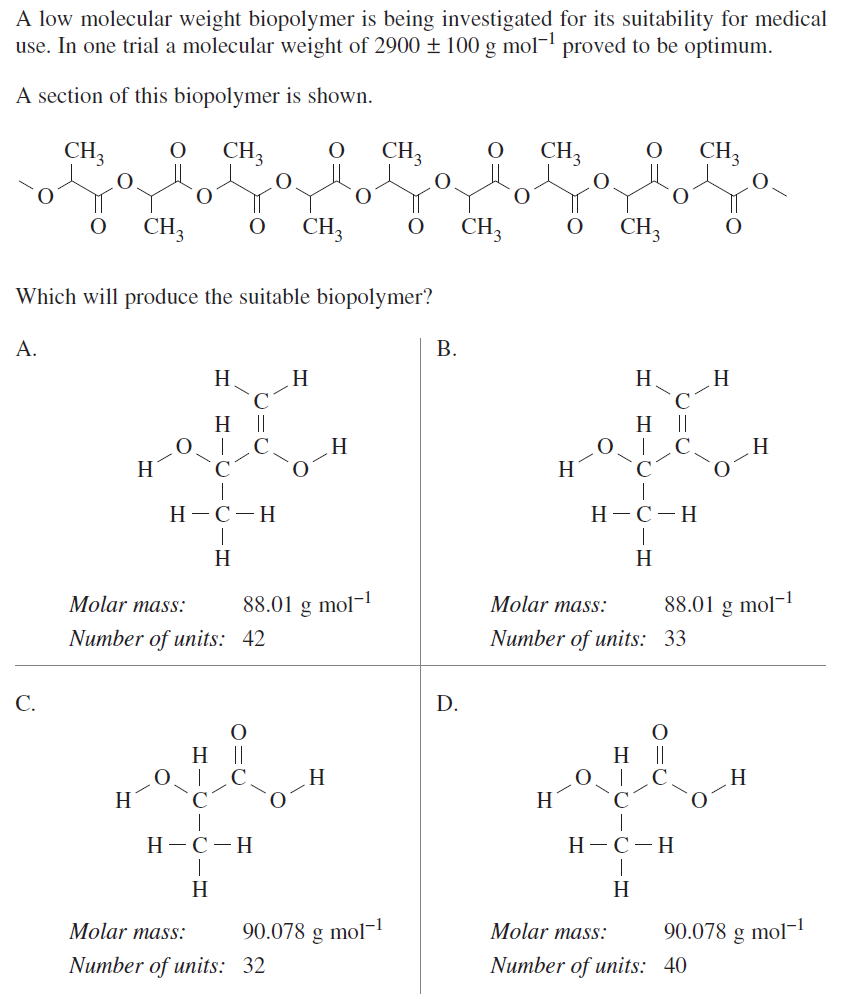
📝 Case Study 1 — 2022 HSC Q18 · PHB Biopolymer MW Selection
Question analysis
- What's being tested: recognising the biopolymer as a condensation polymer (1-monomer self-condensation) and applying the MW formula (
n × MW(monomer) − (n−1) × 18.016). - Key clue in the diagram: the polymer section shows ester linkages (–C(=O)–O–) with a repeating –CH₃ side group → this is a polyester biopolymer (PHB).
- Formula to apply: the 1-monomer condensation formula from §3.3 (you already know it).
Solution — calculate all 4 options
A. MW = 88.01 g/mol, n = 42 → 42 × 88.01 − 41 × 18.016 = 3696.42 − 738.66 = 2957.8 g/mol (within +57 of 2900) ⚠️
B. MW = 88.01 g/mol, n = 33 → 33 × 88.01 − 32 × 18.016 = 2904.3 − 576.5 = 2327.8 g/mol ❌ too low
C. MW = 90.078 g/mol, n = 32 → 32 × 90.078 − 31 × 18.016 = 2882.5 − 558.5 = 2324.0 g/mol ❌ too low
D. MW = 90.078 g/mol, n = 40 → 40 × 90.078 − 39 × 18.016 = 3603.1 − 702.6 = 2900.5 g/mol ✅ almost exactly 2900
Answer: D. Two further clues confirm D:
- Option A's monomer contains a C=C double bond (the parallel lines in the A/B structures). That's an unsaturated monomer suitable for addition polymerisation — but the polymer section in the question is a condensation polymer with ester linkages. Even if A's monomer underwent self-condensation, it would not produce the PHB-style structure shown.
- Option D's monomer is saturated with –OH at one end and –COOH at the other → precisely a 1-monomer condensation polyester building block. MW 90.078 g/mol = HOCH₂CH₂COOH (3-hydroxypropanoic acid) — the short-chain cousin of the actual PHB monomer.
- Biopolymer doesn't mean a different formula — the (n−1)·18 formula from §3.3 applies as-is.
- When sifting options, check the monomer for saturated vs unsaturated first — that alone usually halves the choices.
- If you're short on time, calculate the option with the saturated monomer and the largest n first — it's usually where the answer lives.
📝 Case Study 2 — 2024 HSC Q14 · Silk + Glycine: Identifying the Second Monomer
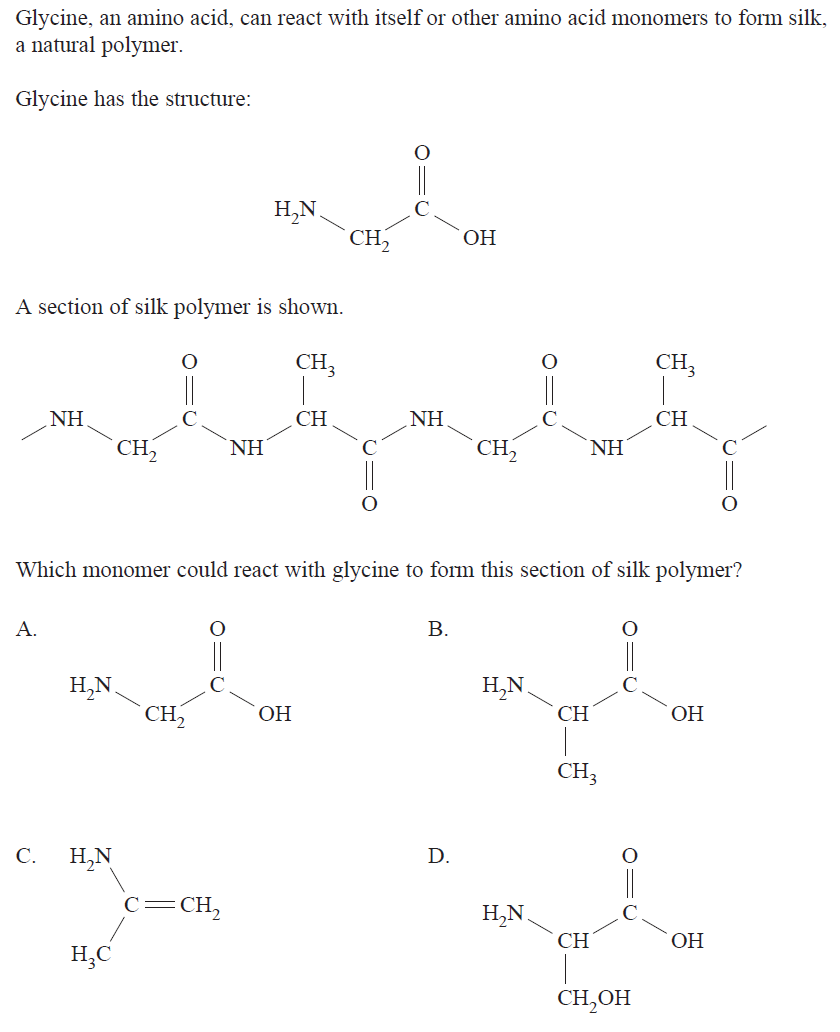
Question analysis
- What's being tested: identifying the second amino acid residue in the silk polymer section — a direct application of the cut-across-the-link technique from §2.1.
- Key clue: the silk section shows two alternating residues. One is –CH₂– (glycine); the other is –CH(CH₃)– (an amino acid with a CH₃ side group).
- Requirement: the second monomer must also be an amino acid (it needs both –NH₂ and –COOH for self-condensation into a peptide chain).
Solution — apply cut-across-the-link
Cut across each peptide bond (–C(=O)–N(H)–) in the silk section, adding H to the N side and OH to the C=O side (the §2.1 technique). This recovers the two amino acid monomers:
- Residue 1 (–CH₂–): H₂N–CH₂–COOH = glycine ✓ (given)
- Residue 2 (–CH(CH₃)–): H₂N–CH(CH₃)–COOH = this is the second monomer we're looking for
Check each option:
A. H₂N–CH₂–COOH (= glycine itself). ❌ The second residue must differ from glycine — if they were the same, the polymer would be polyglycine, not silk.
B. H₂N–CH(CH₃)–COOH (= alanine). ✅ Matches the –CH(CH₃)– in the silk section exactly, and it's a valid amino acid (both –NH₂ and –COOH present).
C. H₂N–C(CH₃)=CH₂. ❌ No –COOH — cannot self-condense into an amide-linked polymer. Not a complete amino acid.
D. H₂N–CH(CH₂OH)–COOH (= serine). ❌ Side group is –CH₂OH, which doesn't match the –CH(CH₃)– in the silk section.
Answer: B (alanine). Real silk is a polypeptide of glycine + alanine + several other amino acids.
- Cut-across-the-link works on amino acid polymers too — it's not a new technique.
- When sifting options, match the side group (CH₃, CH₂OH, etc.) first — this is the fastest filter.
- Any candidate must have both –NH₂ and –COOH to qualify as an amino acid (this immediately eliminates option C).
- Remember: silk is "natural nylon" — the peptide bond (–CO–NH–) is chemically identical to the amide bond in Nylon-6,6.
Why we grouped these two questions together
Both the 2022 PHB question and the 2024 silk/glycine question are variations of the same condensation polymer mechanism. If you've mastered §2.1–2.3 and §3.3, you can solve these "out-of-syllabus" questions using the exact same toolkit.
The three patterns that unlock every biopolymer question:
- (1) Backbone diagnostic (§2.4) — ester (–CO–O–) → polyester; amide (–CO–NH–) → polyamide.
- (2) Cut-across-the-link (§2.1) — to identify a monomer, cut the link and add H + OH.
- (3) MW formula (§3.3) — 1-monomer condensation loses (n−1) H₂O; 2-monomer loses (2n−1).
The James Ruse 2021 Q26 (PHB 10-mark flagship) follows the same patterns — see Part 5 Model Answers Q6 for the full worked solution.
Self-check — what's the 3-step checklist for reducing any biopolymer question to a syllabus polymer question?
- What's in the backbone? Ester (–CO–O–) → polyester; amide (–CO–NH–) → polyamide. (§2.4)
- Do I need to identify a monomer? Use the cut-across-the-link technique (§2.1).
- Do I need to calculate MW? Decide 1-monomer vs 2-monomer, then apply the appropriate formula (§3.3).
Memorise these three steps — when NESA throws a new biopolymer at you, the same toolkit handles it.
3.3 Molecular Weight (MW) Calculation
This is the single most frequently-tested polymer calculation in HSC and trial papers. 2025 HSC Q16 tests it directly. NEAP (every year), QATS, CSSA, Strathfield, Meriden, James Ruse, Knox, Loreto, Exam Choice, and many more have rotated through it. Master the two formulae and you've collected a guaranteed mark.
The two formulae (recap from §2.4)
Addition: MW(polymer) = n × MW(monomer)
Condensation (1-monomer): MW(polymer) = n × MW(monomer) − (n−1) × 18.016
Condensation (2-monomer): MW(polymer) = n × [MW(A) + MW(B)] − (2n−1) × 18.016
How to pick which formula — 30-second decision tree
- Is the polymer addition (C–C/C–H backbone only)? → use the addition formula. No water lost.
- Is it condensation (–C(=O)–O– or –C(=O)–N(H)– in chain)? Go to step 3.
- Does the question give you ONE monomer with two different functional groups (e.g. amino acid –NH2 + –COOH; hydroxy acid –OH + –COOH)? → 1-monomer formula, lose (n−1) waters.
- Does the question give you TWO monomers (diacid + diol, or diacid + diamine)? → 2-monomer formula, lose (2n−1) waters.
⚠️ Sometimes a question says "n monomers of A and n monomers of B" — that's 2-monomer with total 2n monomers and (2n−1) water losses. Sometimes it says "n monomers, each with both functional groups" — that's 1-monomer with (n−1) water losses. Count the functional groups carefully.
Worked Example 1 — Addition Polymer (Polyethylene)
Question: Calculate the molar mass of polyethylene made from n = 1000 ethylene monomers.
Step 1. Identify type: addition (pure C–C/C–H backbone). Use MW = n × MW(monomer).
Step 2. MW of ethene (CH2=CH2) = 2(12.01) + 4(1.008) = 28.05 g/mol.
Step 3. MW(polymer) = 1000 × 28.05 = 28,054 g/mol (≈ 2.81 × 10⁴ g/mol).
Worked Example 2 — 2025 HSC Q16 (1-Monomer Condensation Polyester)
2025 HSC Q16 (MCQ): A single straight strand of polyester was produced through a condensation reaction of 1000 molecules of 3-hydroxypropanoic acid, HOCH2CH2COOH. What is the approximate molar mass of the strand (g mol−1)?
Options: A. 72,062 B. 72,080 C. 90,060 D. 90,078
Step 1. Identify type: condensation polyester (–OH + –COOH on same monomer → 1-monomer). Use MW = n × MW(monomer) − (n−1) × 18.016.
Step 2. MW of 3-hydroxypropanoic acid (HOCH2CH2COOH = C3H6O3):
3 × 12.01 + 6 × 1.008 + 3 × 16.00 = 36.03 + 6.05 + 48.00 = 90.078 g/mol
Step 3. Apply formula with n = 1000:
MW = 1000 × 90.078 − (1000−1) × 18.016
= 90,078 − 999 × 18.016
= 90,078 − 17,998
= 72,080 g/mol → Answer B
Worked Example 3 — 2-Monomer Condensation (Nylon-6,6)
Question: Calculate the molar mass of Nylon-6,6 made from 500 molecules of adipic acid + 500 molecules of hexamethylenediamine.
Step 1. Identify type: condensation polyamide, 2-monomer (diacid + diamine). Use MW = n[MW(A) + MW(B)] − (2n−1) × 18.016 where n = 500.
Step 2. MWs of monomers:
- Adipic acid: HOOC(CH2)4COOH = C6H10O4 = 6(12.01) + 10(1.008) + 4(16.00) = 146.14 g/mol
- Hexamethylenediamine: H2N(CH2)6NH2 = C6H16N2 = 6(12.01) + 16(1.008) + 2(14.01) = 116.21 g/mol
Step 3. Apply formula:
MW = 500 × (146.14 + 116.21) − (2×500 − 1) × 18.016
= 500 × 262.35 − 999 × 18.016
= 131,175 − 17,998
= 113,177 g/mol (≈ 1.13 × 10⁵ g/mol)
Worked Example 4 — Reverse Calculation (Find n)
NEAP 2023 Q20 (MCQ): A PVC sample has a molar mass of 623,800 g/mol. What is the value of n?
Step 1. Type: addition (PVC is poly(vinyl chloride), pure C–C/C–Cl/C–H backbone). Use MW = n × MW(monomer).
Step 2. MW of vinyl chloride (CH2=CHCl = C2H3Cl) = 2(12.01) + 3(1.008) + 35.45 = 62.50 g/mol.
Step 3. Solve for n:
n = MW(polymer) / MW(monomer) = 623,800 / 62.50 = 9981 ≈ 9982
For addition polymers, the reverse calculation is just simple division. For condensation, you'd need to solve the linear equation MW(polymer) = n·MW(monomer) − (n−1)·18.016 → n(MW − 18) = MW(polymer) − 18.
Common pitfalls — checklist before submitting your answer
- ✅ Did I correctly identify addition vs condensation? (Look at the chain — any O or N in the backbone?)
- ✅ For condensation: did I count 1-monomer vs 2-monomer correctly? (1-monomer = (n−1) waters; 2-monomer = (2n−1) waters)
- ✅ Did I use the correct MW(monomer)? Re-check with H + C + N + O + Cl + F atomic masses.
- ✅ Does my answer have realistic magnitude? Polymers are typically 104–106 g/mol — if you got 102, you mis-identified the monomer; if you got 108, you wrote (n−1) waters instead of (n−1)×18.
Self-check — what's the MW of a strand of polyglycine with n = 1000 glycine units?
Type: 1-monomer condensation polyamide (glycine has –NH2 + –COOH on the same molecule).
MW(glycine) = H2NCH2COOH = C2H5NO2 = 2(12.01) + 5(1.008) + 14.01 + 2(16.00) = 75.07 g/mol
MW(polymer) = 1000 × 75.07 − (1000−1) × 18.016 = 75,070 − 17,998 = 57,072 g/mol ≈ 5.7 × 10⁴ g/mol
(This is the exact answer pattern of James Ruse 2023 Q12.)
🎯 Part 3 Mini-Checkpoint — 2 questions before you move on
Q1. Kevlar is an aromatic polyamide. Using the backbone diagnostic, explain how an unseen Kevlar structure should be classified, and identify the structural feature responsible for its exceptional tensile strength. (3 marks, 2025 HSC Q28 style)
The Kevlar backbone shows –CO–NH– (amide) linkages at regular intervals, so it is a condensation polymer (polyamide). Two structural features give Kevlar its exceptional tensile strength: (1) strong inter-chain hydrogen bonds between the polar N–H donor and C=O acceptor in adjacent chains, locking the chains together in stacked sheets; and (2) the rigid, flat aromatic rings in the backbone, which stop the chains kinking and let them pack very closely in a fixed alignment — this both keeps every N–H and C=O correctly lined up for hydrogen bonding and maximises the dispersion forces acting along the whole chain. Together these forces produce a fibre stronger by weight than steel.
Q2. A condensation polymer is built from 800 molecules of a single monomer with MW = 88.06 g/mol. Calculate the polymer's molar mass and compare it to the addition-polymer mass that the same monomer mass would give. (3 marks)
Condensation: MW = 800 × 88.06 − (1599) × 18.016 = 70 448 − 28 808 = 41 640 g/mol
Addition (hypothetical): MW = 800 × 88.06 = 70 448 g/mol
The condensation polymer is ~28 800 g/mol lighter because 1599 H2O molecules are eliminated during polymerisation (one per amide/ester link, with 2n−1 links in the chain). The water loss is the entire reason the two formulae differ.
Part 4 · Revision Tools
The Polymer Master Table — every polymer, every facet
One table to rule them all. Each row is one of the 9 polymers covered in this guide. Click any column header to sort; use the filter chips to show only addition or only condensation polymers. This is your one-page memorisation hub for the night before the exam.
⭐ Mini-Core Table — the 6 syllabus polymers only memorise
If you remember only one thing, remember this table. Six rows, five columns — every cell is exam-tested.
| Polymer | Type | Defining structural feature | Primary IMF | Use because… |
|---|---|---|---|---|
| PE LDPE / HDPE | Addition | Branching ↔ chain packing (only difference between the two) | Dispersion | LDPE: flexible bags · HDPE: rigid jugs |
| PVC PVC | Addition | Polar C–Cl side group on every 2nd C | Dipole-dipole | Rigid pipes · plasticised → flexible wire insulation |
| PS PS | Addition | Bulky phenyl side group → amorphous | Dispersion only | CD cases · gas-expanded → Styrofoam cups |
| PTFE PTFE | Addition | All 4 H replaced by F → very strong C–F bonds | Enhanced dispersion | Non-stick cookware · inert + low friction |
| Nylon Nylon-6,6 | Condensation | –CO–NH– amide links (N–H donor + C=O acceptor) | H-bonds | Stockings · strong + elastic recovery |
| PET PET | Condensation | Aromatic rings + ester (–CO–O–) links | Dipole-dipole + π–π | Drink bottles · rigid + transparent + tough |
→ Full 9-row interactive table below splits PE into LDPE + HDPE (since they're often compared) and adds the Kevlar + PHB extension polymers — sortable/filterable, with repeat-unit images.
| Polymer ⇅ | Type ⇅ | Monomer(s) | Repeating Unit | Primary IMF ⇅ | Key Properties | Main Uses |
|---|---|---|---|---|---|---|
| LDPE | Addition | Ethene (ethylene) | −(CH2−CH2)n− · branched | Dispersion (weak) | Flexible · low density (~0.92) · translucent · inert | Plastic bags, cling film |
| HDPE | Addition | Ethene (ethylene) | −(CH2−CH2)n− · linear | Dispersion (stronger via packing) | Rigid · high density (~0.95) · opaque · inert | Milk jugs, water pipes, buckets |
| PVC | Addition | Chloroethene (vinyl chloride) | −(CH2−CHCl)n− | Dipole–dipole (polar C–Cl) | Rigid (plasticised → flexible) · UV-sensitive · cheap | Pipes, electrical insulation, vinyl flooring |
| PS | Addition | Ethenylbenzene (styrene) | −(CH2−CH(C6H5))n− | Dispersion only | Brittle · transparent · lightweight · low cost | CD cases, foam packaging (Type 2 = Styrofoam) |
| PTFE | Addition | Tetrafluoroethene | −(CF2−CF2)n− | Dispersion (enhanced by F density) | Inert · low friction · very high m.p. | Non-stick coatings, Gore-Tex, plumber's tape |
| Nylon-6,6 | Condensation | Adipic acid + hexamethylenediamine | −[CO−(CH2)4−CO−NH−(CH2)6−NH]n− | H-bond (N–H ↔ C=O) | Strong + elastic · high m.p. (~265 °C) · hygroscopic | Stockings, fishing line, ropes, carpet |
| PET | Condensation | Terephthalic acid + ethylene glycol | −[O−CH2CH2−O−CO−C6H4−CO]n− | Dipole–dipole + dispersion | Tough · transparent · stain-resistant · high m.p. (~260 °C) | Drink bottles, polyester fibres, films |
| Kevlar | Condensation | Terephthalic acid + 1,4-diaminobenzene | −[NH−C6H4−NH−CO−C6H4−CO]n− | H-bond + dispersion (max) | Extreme tensile strength · heat-resistant · low density | Body armour, ropes, aerospace |
| PHB | Condensation | 3-hydroxybutanoic acid (1-monomer) | −[O−CH(CH3)−CH2−CO]n− | Dipole–dipole (polar C=O) | Biodegradable · biocompatible · brittle when dry | Medical sutures, drug-release films |
IMF strength legend: 1 = dispersion only · 2 = dipole–dipole · 3 = H-bond. (Sort by IMF column to rank chains by attraction strength.)
Flashcards — Monomer ↔ Polymer ↔ Properties ↔ Uses
Click any card to flip. Front shows the polymer + monomer; back shows properties, uses, and the structural reason behind them. Drill these until you can recite both sides — this is the four-way mapping NESA asks you to "model and compare."
Branched chains, amorphous packing.
PROPERTIES
- Flexible, low density (~0.92)
- Translucent
- Chemically inert
USES
- Plastic shopping bags · cling film · squeeze bottles
Linear chains, crystalline packing.
PROPERTIES
- Rigid, high density (~0.95)
- Opaque, higher m.p. (~135 °C)
- Chemically inert
USES
- Milk jugs · water pipes · buckets · toys
(vinyl chloride, CH2=CHCl)
PROPERTIES
- Rigid (plasticised → flexible)
- UV-sensitive · slightly transparent
- Low cost
USES
- Pipes · electrical wire insulation · window frames · vinyl flooring
(styrene, CH2=CH(C6H5))
PROPERTIES
- Brittle (Type 1) / lightweight foam (Type 2)
- Transparent · low cost
- Dissolves in non-polar solvents
USES
- CD cases · disposable cups · Styrofoam packaging · insulation
(CF2=CF2) · brand: Teflon™
PROPERTIES
- Extremely inert
- Very low friction
- Heat-resistant (very high m.p.)
USES
- Non-stick cookware · Gore-Tex membrane · plumber's tape · bearings
(each 6 C → "6,6")
PROPERTIES
- Very high tensile strength
- Elastic (H-bonds re-form after stretch)
- Hygroscopic · m.p. ~265 °C
USES
- Stockings · fishing line · ropes · carpet · engineering plastics
(aromatic diacid + 2-C diol)
PROPERTIES
- Tough · transparent · m.p. ~260 °C
- Hydrophobic · stain-resistant
- UV-resistant
USES
- Drink bottles · polyester clothing · films · X-ray film
(both aromatic)
PROPERTIES
- Extreme tensile strength (many times stronger than steel by weight)
- Low density · heat-resistant
- Chemically inert
USES
- Body armour · aerospace · ropes · brake pads · sail fabric
📋 The Polymers Cheat Sheet — print this for revision
Everything in one page. The same information lives in the 📋 floating panel (bottom-right) for quick reference, but this version is sized for printing and final-night review. Use Ctrl/Cmd + P to print just this section.
📐 MW Calculation Formulae
Addition polymer
Condensation (1-monomer)
Condensation (2-monomer)
⚠️ The trap: forgetting the −(n−1)·18 term in condensation. 2025 HSC Q16's wrong-answer option D = forgot this.
🏗️ 4/5-Step Compare Scaffold
✏️ The Drawing Rule
When NESA asks you to draw the polymer from a monomer:
Show ≥ 3 monomer units
Or pair the full structural form with the abbreviated bracketed form −(...)n−. Either earns the drawing mark; combining both is safest.
✂️ Cut-Across-the-Link Technique
To find the monomer of a condensation polymer:
- Locate the link: −C(=O)−O− (ester) or −C(=O)−N(H)− (amide)
- Cut across between C=O and the O or N atom
- Add H → N/O side · Add OH → C=O side
Why it works: condensation lost H2O at each link, so "undoing" the link adds H2O back — one H to one side, one OH to the other.
🧪 Quick Distinguishing Tests
Bromine water (monomer vs polymer)
- Monomer: decolourises (C=C reacts with Br2)
- Polymer: no reaction (only C–C left)
State at RT (1-mark gateway Q)
- Polymer = solid (long chains → strong dispersion)
- Monomer = gas (small molecule → weak dispersion)
Addition vs Condensation backbone
- Pure C–C in chain → addition
- –C(=O)–O– or –C(=O)–N(H)– in chain → condensation
🎯 NESA Verb → Answer Opener
| Draw | ≥3 units; abbreviated form too |
| Identify monomer | Cut across the link |
| Calculate MW | Addition or condensation formula |
| Compare | 4/5-step scaffold |
| Explain X stronger | H-bond > dipole > dispersion |
| Outline difference | π-bond breaks vs H2O eliminated |
| Justify can polymerise? | Addition: C=C? · Cond: ≥2 functional groups? |
| Predict / which monomer | Match repeat unit ↔ functional groups |
⏱ 2-Minute Pre-Exam Checklist core
Last 120 seconds before the bell. Re-read these two boxes — nothing else.
📜 The 6-Line Polymer Summary
- Addition = C=C π-bond opens → backbone is all C–C. 4 syllabus polymers: PE · PVC · PS · PTFE.
- Condensation = two functional groups join, H2O eliminated → backbone has ester or amide links. 2 syllabus polymers: Nylon · PET.
- Properties depend on crystallinity, branching, chain length, side groups, polar bonds — name 2-3 per polymer.
- Causal chain for every "Use → Properties → Structure" Q: structural feature → IMF type → bulk property → use.
- Drawing = show ≥ 3 monomer units, then optionally the −(...)n− form.
- MW — Addition: n × MW(monomer). Condensation: n × MW − (2n−1) × 18.016.
- Did I look at the backbone first? (addition or condensation?)
- Did I check what the verb wants? (draw vs compare vs identify)
- Did I list 2-3 properties with the structural reason behind each?
- If MW: did I subtract (2n−1) × 18 for condensation?
- Drawing only 1 repeat unit (need ≥ 3).
- Saying "stronger IMF" without naming which kind (H-bond / dipole / dispersion).
- Mixing up amide (–CO–NH–) vs ester (–CO–O–) links.
- MW: forgetting to subtract water in condensation.
- Calling PET an addition polymer because "it has C=O" — backbone test wins.
- "The C–C only backbone shows…"
- "This contains C=O ester linkages, therefore…"
- "The branched chains in LDPE prevent close packing, which lowers density."
- "The amide N–H allows H-bonding between chains, giving Nylon a higher tensile strength than PE."
Part 5 · Past Exam Questions
MCQ Quiz — 12 questions from NESA + Trials
Click the option you think is correct. You'll get immediate feedback + a short explanation citing where in the guide to revise. Your score appears at the end. Mix of NESA HSC 2020–2025 + selected high-yield trial items.
⚠️ One attempt per question. Your first click is locked in and cannot be changed — just like the real exam. Commit to an answer before you click. Use Reset Quiz at the bottom if you want to run the whole set again.
🎯 Quiz Complete!
Your score:
—
Extended Response — Model Answers (6 worked questions)
Each panel below is a worked extended-response question with full marker-friendly answer. Click to expand. Source mix: NESA HSC, CSSA, Sydney Boys, James Ruse, and SKY HSC College HW Exercises 1 & 2. Two more model answers already live elsewhere in this guide: §1.4 (LDPE vs HDPE) and §2.5 (Nylon vs PET).
Q1 · 2024 HSC Q22 — Draw a 6-carbon section of poly(vinyl fluoride) 2 marks
Question: Vinyl fluoride can be polymerised. In the box provided, draw the structural formula for a 6-carbon section of the polymer formed from the polymerisation of vinyl fluoride.
Monomer structure: CH2=CHF (vinyl fluoride / fluoroethene)
Step 1. Identify: addition polymerisation. The C=C opens to C–C single bond.
Step 2. 6 carbons = 3 monomer units (each monomer has 2 C). Link them by C–C single bonds. Place F on every second C (same position as in the monomer); H on the others.
−CH2−CHF−CH2−CHF−CH2−CHF−
(3 monomer units · 6 carbons total · C=C have opened to C–C)
Marker tips:
- 1 mark for correct connectivity (C–C single bonds, no C=C).
- 1 mark for correct substituent placement (F every second C, not every C).
- Lose marks if you draw fewer than 3 monomer units, or if you leave a C=C in the product.
Q2 · HW Ex 1 Q31 — Compare LDPE and PVC (structure, properties, uses) 8 marks
Question: Compare LDPE and PVC by referring to their structures, properties and uses.
Approach: full 4-step scaffold from §1.4.
Step 1 · Equations
LDPE: n CH2=CH2 → −(CH2−CH2)n− (branched form — catalyst conditions favour branching).
PVC: n CH2=CHCl → −(CH2−CHCl)n− (poly(vinyl chloride); monomer = chloroethene).
Both are addition polymerisations of derivatives of ethene.
Step 2 · Uses
LDPE: plastic shopping bags, cling film (need flexibility + chemical inertness).
PVC: water pipes, electrical wire insulation (need rigidity or flexibility + cheapness + electrical insulation).
Step 3 · Properties
LDPE: flexible + soft (phys), low density ~0.92 (phys), translucent (phys), chemically inert (chem).
PVC: rigid (phys, can be plasticised → flexible), higher density ~1.40 (phys), slightly transparent (phys), UV-sensitive but otherwise chemically inert (chem).
Step 4 · Structure
LDPE: non-polar C–H/C–C only → only dispersion forces between chains; high branching prevents close packing → amorphous → low m.p., flexible, low density.
PVC: polar C–Cl bond on every second C → dipole-dipole forces between chains (stronger than dispersion alone) → higher m.p., more rigid. The bulky Cl side group also adds steric bulk → less branching, more crystallinity.
Synthesis: Both polymers are made by the same type of reaction (addition polymerisation of an unsaturated monomer), but their different IMF types — dispersion only for LDPE vs dipole-dipole + dispersion for PVC — drive every property and use difference between them.
Q3 · HW Ex 2 Q19 — Compare nylon vs polyester (flagship model answer) 5 marks
Question: Compare nylon and polyester by referring to their structures, properties and uses.
Approach: 5-step scaffold from §2.5 — both are condensation polymers, so Checklist item 5 (polar bonds in backbone) is decisive.
Structure & synthesis:
- Nylon-6,6 = polyamide made by condensation of adipic acid + hexamethylenediamine. Backbone has −C(=O)−N(H)− amide links.
- Polyester (PET) = made by condensation of terephthalic acid + ethylene glycol. Backbone has −C(=O)−O− ester links and aromatic rings.
Inter-chain IMFs (the critical Checklist-item-5 difference):
Nylon: has both N–H (H-bond donor) and C=O (H-bond acceptor) → adjacent chains form strong H-bonds at every amide link.
PET: has C=O (acceptor) but no N–H donor → only dipole-dipole forces (between C=O groups) + π-stacking between aromatic rings.
Properties (consequence):
- Nylon: elastic (H-bonds break + re-form under stretch), very high tensile strength, hygroscopic.
- PET: rigid (aromatic backbone) + transparent + hydrophobic, slightly higher m.p. than Nylon, less elastic.
Uses (matched to properties):
- Nylon: stockings, fishing line, ropes — needing elasticity + strength.
- PET: drink bottles, clothing fibres — needing rigidity + transparency + chemical resistance.
Conclusion: Although both are condensation polymers, the presence of N–H bonds in nylon (absent in PET) explains nylon's elastic + hygroscopic behaviour, while PET's rigid aromatic backbone + π-stacking explain its tougher, more transparent character.
Q4 · CSSA 2019 Q33 — Density-flotation polymer identification + comparison 7 marks
Question: A student is given samples of two unknown addition polymers, both made from derivatives of ethene. (a) Describe a practical procedure using density flotation in water + ethanol mixtures to identify whether each sample is LDPE or HDPE. (b) For TWO addition polymers of ethene, compare their structures, properties and uses.
(a) Density-flotation procedure (3 marks):
- Prepare a series of water-ethanol mixtures of known density spanning ~0.79 to 1.00 g/cm³ (ethanol ρ = 0.79; water ρ = 1.00).
- Place a small piece of polymer sample in each mixture. Observe whether it floats, sinks, or is neutrally buoyant.
- The mixture in which the sample is neutrally buoyant has the density of the sample. LDPE (~0.92 g/cm³) is neutrally buoyant in a ~80:20 water:ethanol mix; HDPE (~0.95 g/cm³) is neutrally buoyant in a ~90:10 mix.
(b) Compare two addition polymers — using LDPE and HDPE (4 marks):
Both are polyethylene made by addition polymerisation of ethene; the catalyst determines branching.
LDPE: branched chains → can't pack → amorphous → low density (0.92), flexible, translucent → used in plastic bags, cling film.
HDPE: linear chains → tight packing → crystalline → higher density (0.95), rigid, opaque → used in milk jugs, water pipes.
Both polymers are chemically inert because their backbones contain only strong, non-polar C–C and C–H bonds — neither contains polar functional groups (no –OH, –COOH, –NH2) for acids, bases, or water to react with.
Q5 · Sydney Boys 2022 Q29 — Kevlar segment + tensile strength explanation 4 marks
Question: Kevlar is a synthetic polymer used in body armour. (a) Draw a section of the Kevlar polymer chain showing 2 repeat units (2 marks). (b) Explain in terms of intermolecular forces how Kevlar's structure gives it extremely high tensile strength (2 marks).
(a) Kevlar 2-unit section:
−N(H)−C6H4−N(H)−C(=O)−C6H4−C(=O)−N(H)−C6H4−N(H)−C(=O)−C6H4−C(=O)−
(2 repeat units · amide links shown with C=O double bond + N–H single bond)
(b) Why Kevlar is so strong (2 marks):
Adjacent Kevlar chains attract through TWO reinforcing IMFs:
- Hydrogen bonds between the polar N–H of one chain (δ+ donor) and the C=O of an adjacent chain (δ− acceptor) — formed at every amide link.
- π–π stacking between the planar aromatic rings of adjacent chains — adding dispersion-class attraction along the entire backbone.
Because the aromatic rings keep the chains rigid and perfectly aligned, the H-bonds form in ideal geometry at every monomer unit, maximising the H-bond + π-stack density per unit length. This gives Kevlar its extreme tensile strength — many times stronger than steel by weight.
Q6 · James Ruse 2021 Q26 — PHB biopolymer (5-part flagship question) 10 marks · the most comprehensive polymer Q in the trial archive
Question: Polyhydroxybutyrate (PHB) is a biopolymer being trialled as a biodegradable alternative to petrochemical plastics. Its monomer is 3-hydroxybutanoic acid (HOCH(CH3)CH2COOH; MW = 104.10 g/mol).
(a) Give the IUPAC name of the monomer (1 mark).
3-hydroxybutanoic acid (the carbon chain is butanoic acid; the OH is on carbon 3, counting from the COOH carbon).
(b) Draw a section of PHB showing 2 monomer units, including the by-product of the reaction (2 marks).
HOCH(CH3)CH2COOH + HOCH(CH3)CH2COOH
↓
HOCH(CH3)CH2C(=O)−O−CH(CH3)CH2COOH + H2O
2 monomers join by ester linkage (–OH of one + –COOH of the other → –O–C(=O)– + H2O).
(c) PHB has solubility 53.9 g per 100 mL in a particular solvent. Calculate the molar concentration (2 marks).
Assuming the question refers to the monomer or dimer (i.e. MW = 104.10 g/mol, before polymerisation):
mol = 53.9 / 104.10 = 0.518 mol in 100 mL = 0.100 L
c = 0.518 / 0.100 = 5.18 mol/L (≈ 5.2 mol/L)
(d) Draw a diagram showing the intermolecular forces between PHB and water molecules (2 marks).
PHB has polar C=O groups (in ester linkages) and polar C–O–C ether-like backbone, plus terminal –OH and –COOH groups. Water can H-bond to:
- The C=O carbonyl O (acceptor) — water's O–H δ+ donates to C=O δ−.
- The ester –O– (acceptor, weaker) — also accepts H-bond from water O–H.
- Terminal –OH and –COOH can both donate AND accept H-bonds with water.
(e) Compare TWO environmental implications of using PHB instead of petrochemical polyethylene (3 marks).
1. Biodegradability: Soil bacteria possess depolymerase enzymes that hydrolyse PHB's ester linkages, breaking it back to 3-hydroxybutanoic acid (a natural metabolite) within weeks to months. Petrochemical PE has only C–C/C–H bonds with no enzymatic pathway → persists in environment for 10–100+ years. Reduces persistent plastic waste in landfill and oceans.
2. Carbon cycle: PHB is produced by bacterial fermentation of sugars (or directly from CO2 in some strains). The carbon in PHB came from atmospheric CO2 via photosynthesis; when PHB biodegrades, that CO2 is returned to the atmosphere — net-zero carbon over its life-cycle. PE's carbon comes from fossil-fuel feedstock; when discarded, it remains as solid waste or, if incinerated, adds new CO2 to the atmosphere — net-positive carbon addition.
Trade-off: PHB currently costs 2–5× more than PE (due to bacterial fermentation cost) and is more brittle, limiting bulk use. As of 2025 it is competitive only in specialty applications (medical sutures, slow-release agricultural films).
• LDPE vs HDPE (6 marks) — see §1.4 4-Step Scaffold
• Nylon-6,6 vs PET (6 marks) — see §2.5 5-Step Scaffold
• Kevlar vs Polystyrene IMF (2025 HSC Q28, 4 marks) — see §3.1 Kevlar
That's 9 complete worked extended-response questions across this guide — covering every NESA verb pattern from 2019 to 2025.
Need more help? SKY HSC College · Strathfield
HSC Chemistry specialists since 2000. Small classes, full past-paper drilling, every exam verb mastered.
Book a trial lesson →Prefer to read it as an article? The full written version of this guide — same chemistry, same model answers, in prose — lives on the SKY blog:
📖 Module 7 IQ6 Polymers — the written guide →
More SKY Chemistry guides: Fossil Fuels vs Biofuels · Safe Handling & Disposal · all guides →
📞 (02) 8012 8488 · ✉️ enquiry@skyedu-hsc.com · 📍 Level 5, Suite 7 / 11 The Boulevarde, Strathfield 2135